Start with a saree
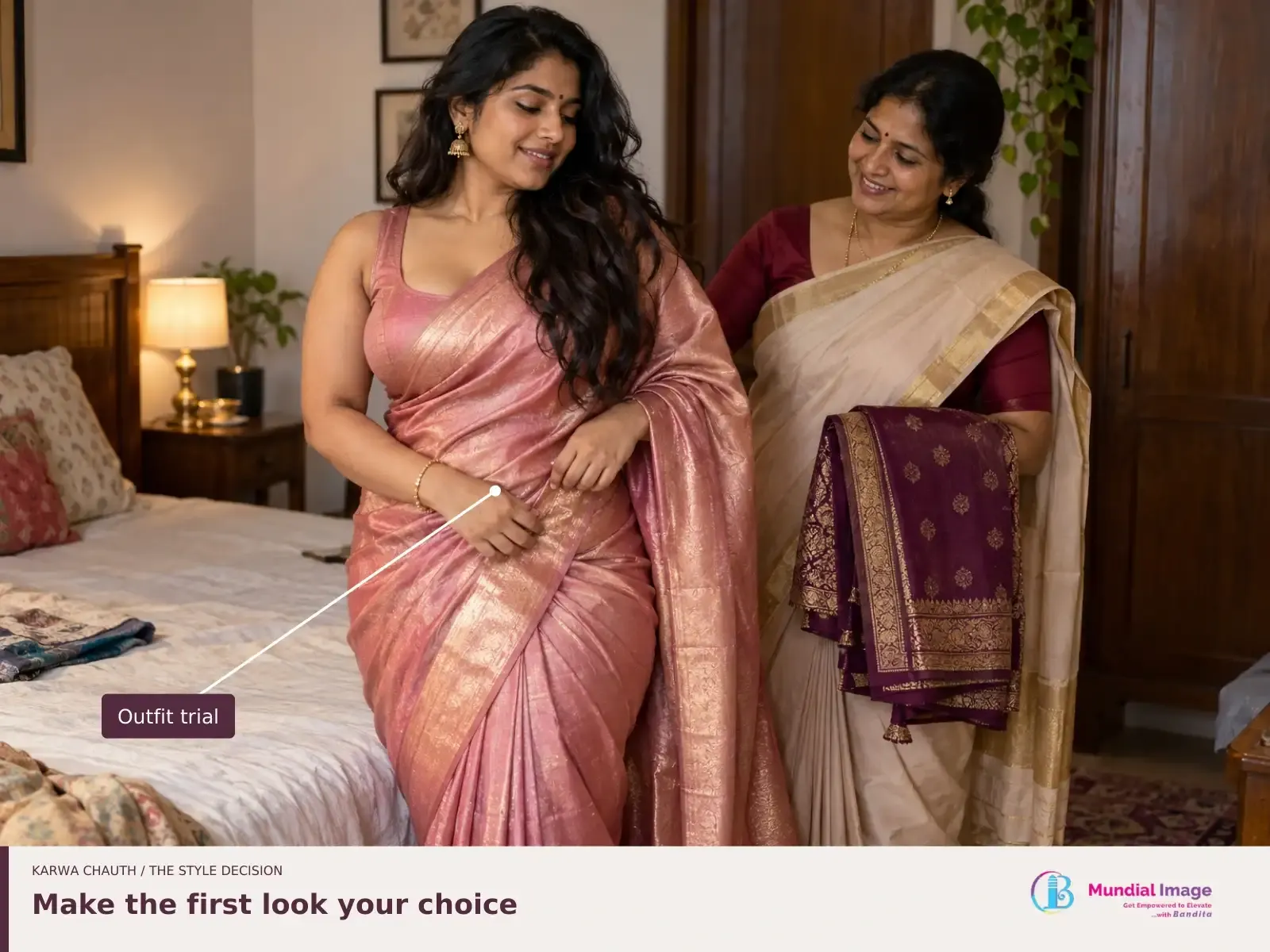
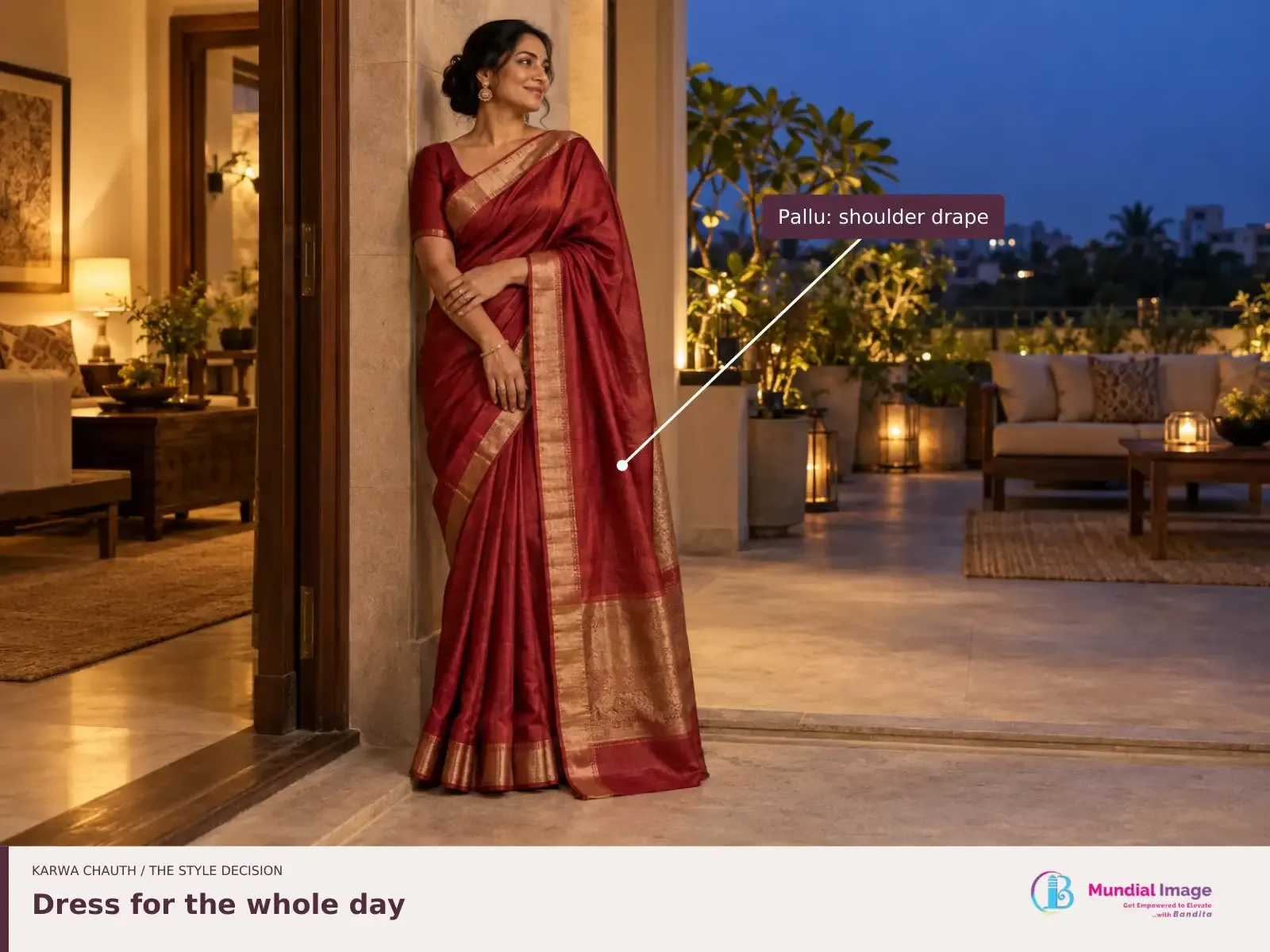
Choose the weave in your hands, not the fabric label. Then plan the blouse and test the drape seated.
Saree ideasOffice 201, Acme Plaza No.2, Andheri Kurla Road, next to JB Nagar metro, Chakala, Andheri East, Mumbai 400059
Mon to Fri, 10 to 6 IST
GuideKarwa Chauth · Thursday 29 October 2026
Sarees, suits, lehengas and the details that make a festive outfit work for the whole day.
Thursday, 29 October 2026
Moonrise 8:17 pm in New Delhi, 9:00 pm in Mumbai.
Drik Panchang, local time. Check your own city.
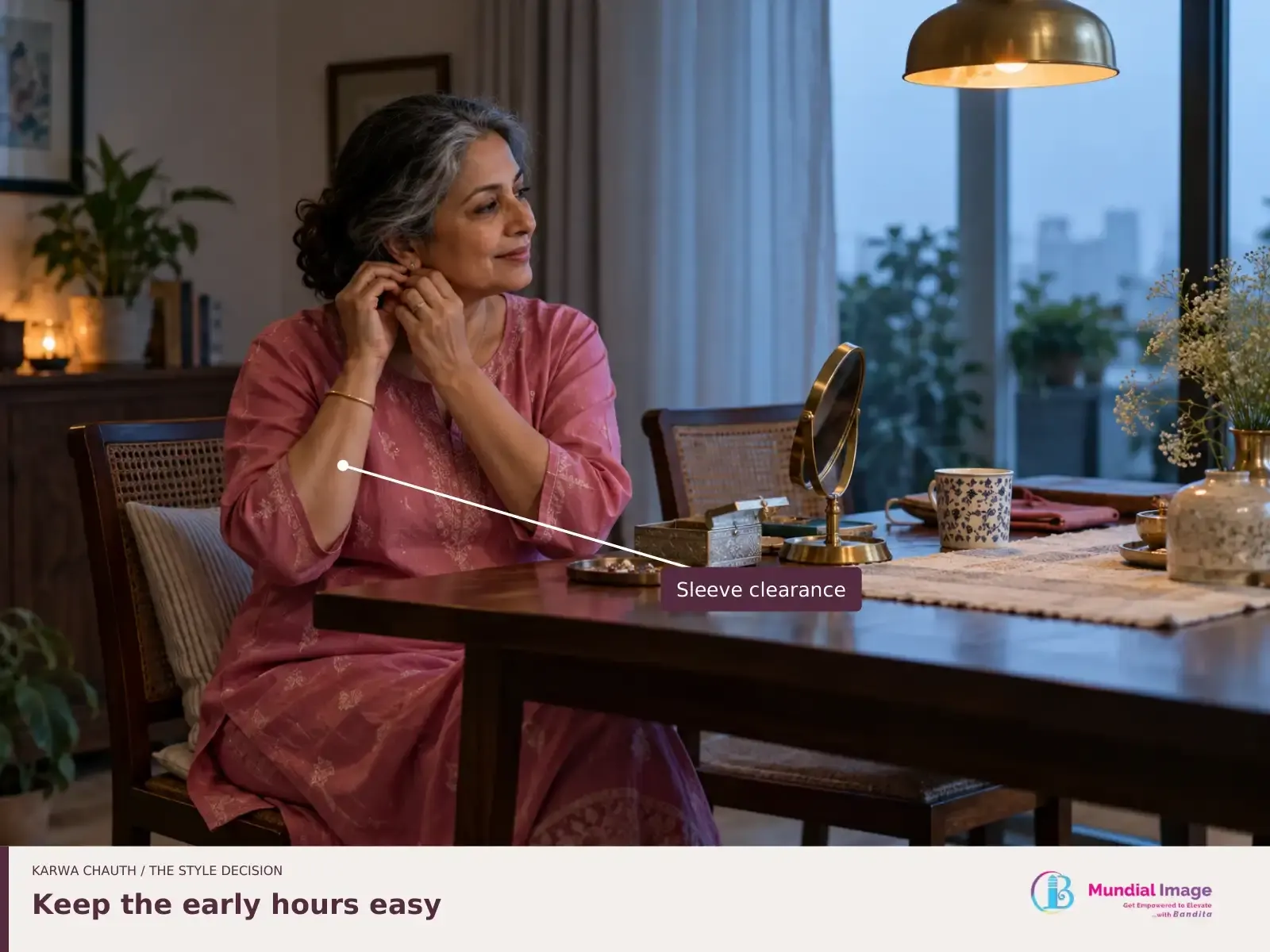
The earrings looked perfect until you turned your head. Now one is caught in the pallu, the blouse pulls when you sit, and the photograph is still two hours away.
These are small styling decisions with a long evening attached. A Karwa Chauth outfit needs room for whatever your day includes: an early start, time at home, a family gathering, puja, stairs, a terrace, photographs. Choosing the saree is only part of that work.
Start with the piece you want to wear. Then make the rest of the outfit answer to the actual day.
The guide, in one line
01The short answer3 min
Choose a saree, suit, anarkali, sharara or lehenga that fits your family's observance and lets you sit, reach and walk comfortably. Plan the blouse or neckline before jewellery, test the complete outfit in evening light, and decide which pieces can wait until puja. An existing wedding garment can be the starting point.
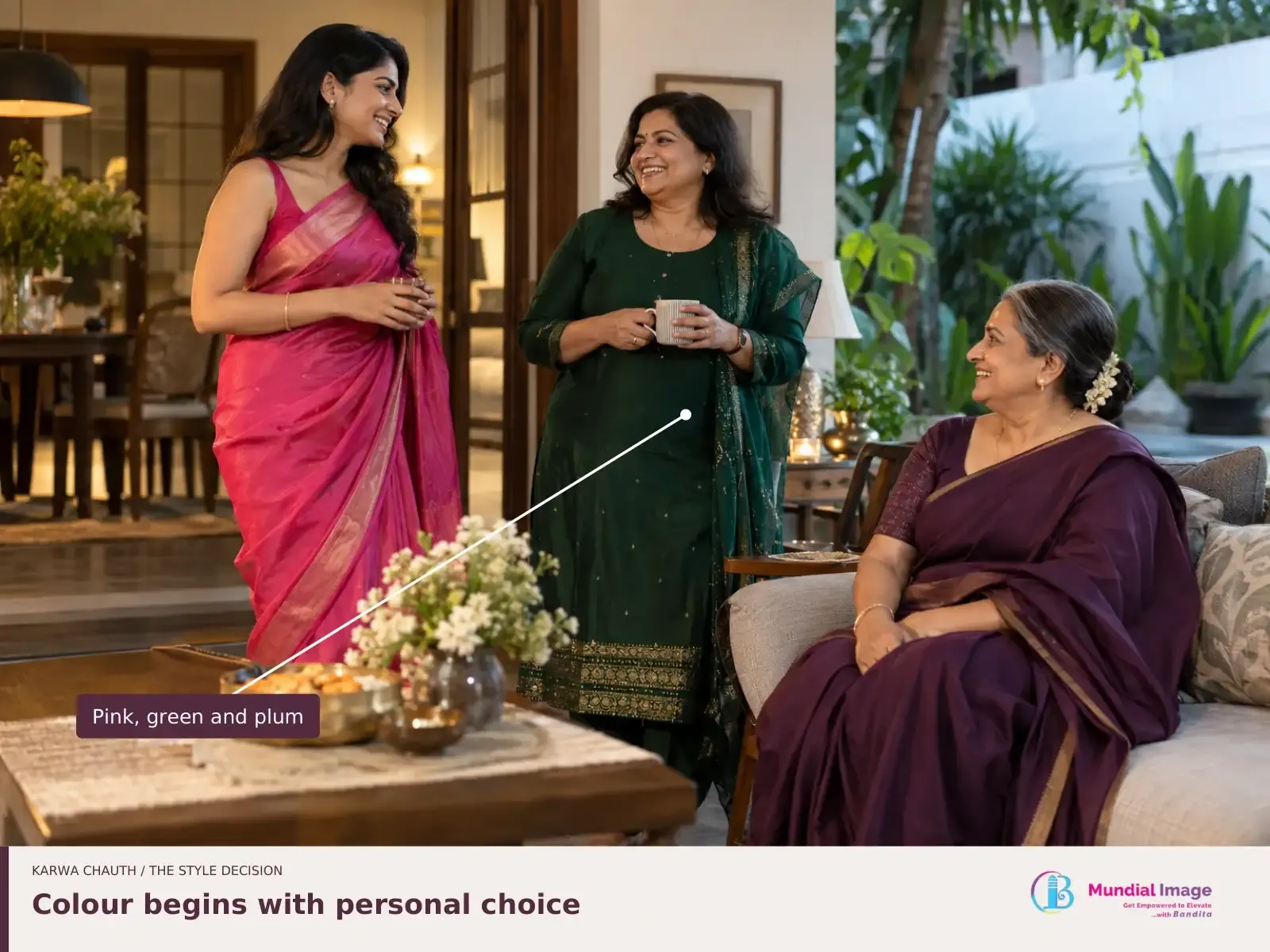
Red remains a familiar option, but it need not determine every part of the look. Pink, wine, green and other colours are possible where they suit your preferences and family customs. No garment category wins for everyone. A well-practised saree wearer may find a light drape easier than a heavily lined anarkali.
Karwa Chauth 2026 falls on Thursday, 29 October in India. Drik Panchang's New Delhi calendar lists puja from 5:38 pm to 6:56 pm and moonrise at 8:17 pm, local time. These are New Delhi timings, not an all-India schedule. Check your city; outside India, even the observance date can differ. A predicted moonrise does not guarantee visibility from a particular balcony.[1]
| City | Puja | Moonrise |
|---|---|---|
| New Delhi | 5:38 pm to 6:56 pm | 8:17 pm |
| Mumbai | 6:07 pm to 7:22 pm | 9:00 pm |
Source: Drik Panchang city calendars for 2026. Local time for each city; other cities differ.
Sargi is associated particularly with Punjabi and related family traditions. It is not part of every household's practice. Use the parts of this guide that fit your observance. The styling suggestions below are recommendations, not religious requirements or fasting advice.[2]
Try itOutfit route finder
Tap one answer in each row. Nothing is saved or sent anywhere.
Choose the weave in your hands, not the fabric label. Then plan the blouse and test the drape seated.
Saree ideasA straight suit with a detailed dupatta, an anarkali or a sharara. Sit, lift your arms and climb a step before deciding.
Suit ideasA lehenga skirt with a quieter blouse, or the embroidered dupatta over a plain suit. Check present-day fit first.
Rewear ideas02Sargi to moonrise1 min
Write down when you will actually change. If the answer is “once, before puja”, the morning outfit does not need to become the evening outfit.
If you are visiting relatives and cannot return home, choose a base that can take a different dupatta or earrings later.
Choose when to change before deciding what to add.
Check: Can you reach across a table without dragging a sleeve?
Check: Is changing realistic with your schedule?
Check: Sit in the car wearing the full outfit.
Check: Rehearse the seating and head covering you expect.
Check: Walk the route to the viewing place.
Check: Take one test picture before everyone gathers.
Only the parts of the day you observe apply.
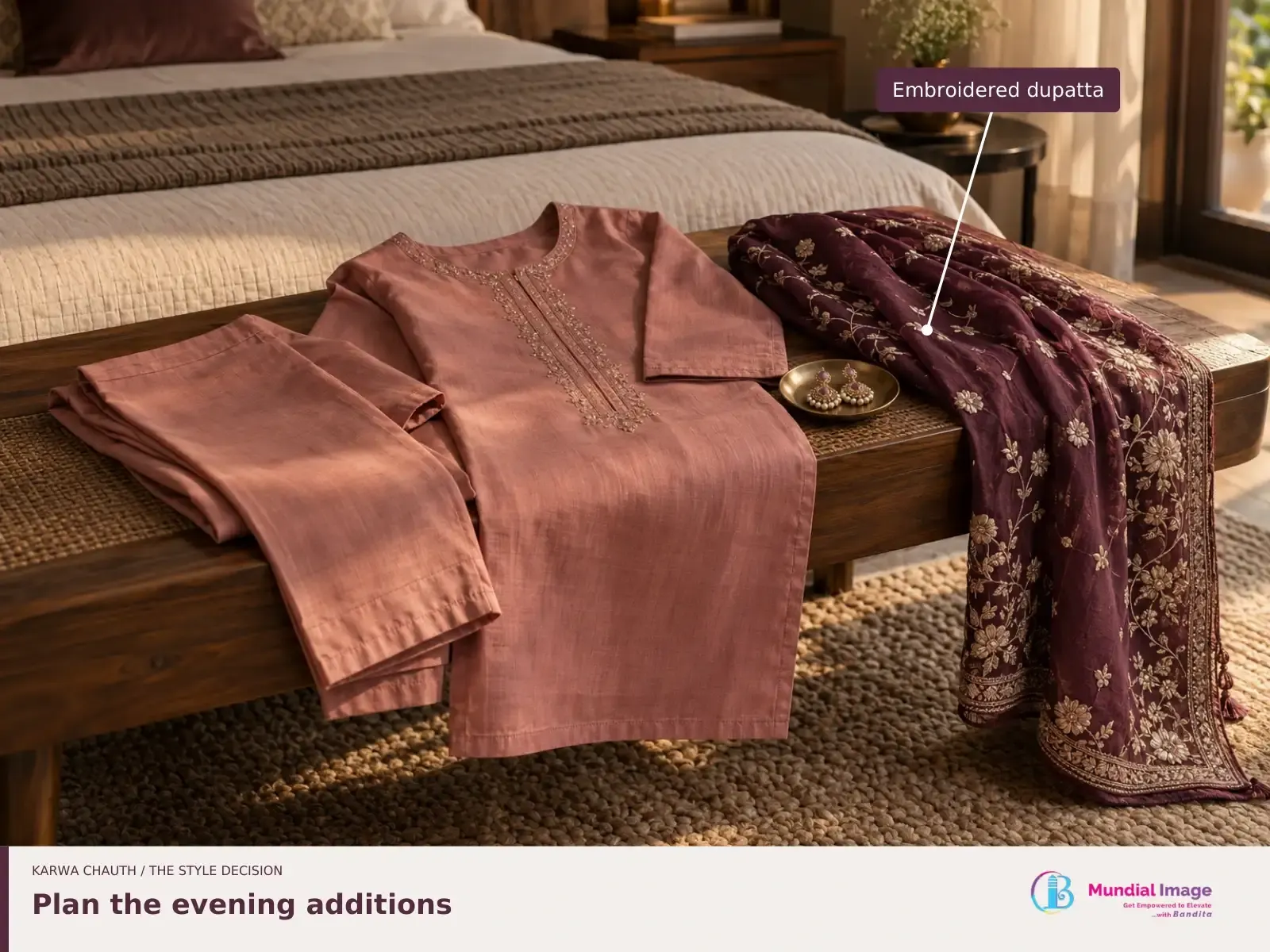
An evening look can begin with a plain rose suit worn earlier. Before puja, add a wedding dupatta, the jewellery you have chosen and a lipstick refresh.
That change works only if the dupatta's weight and neckline were considered together. Adding accessories at the last minute can undo the ease of the base.
03Side by side2 min
Bring the alternatives out of their covers. “Silk”, “anarkali” and “lightweight” are incomplete descriptions.
Lining, embroidery, stiffening, closures and fit can change how each feels.
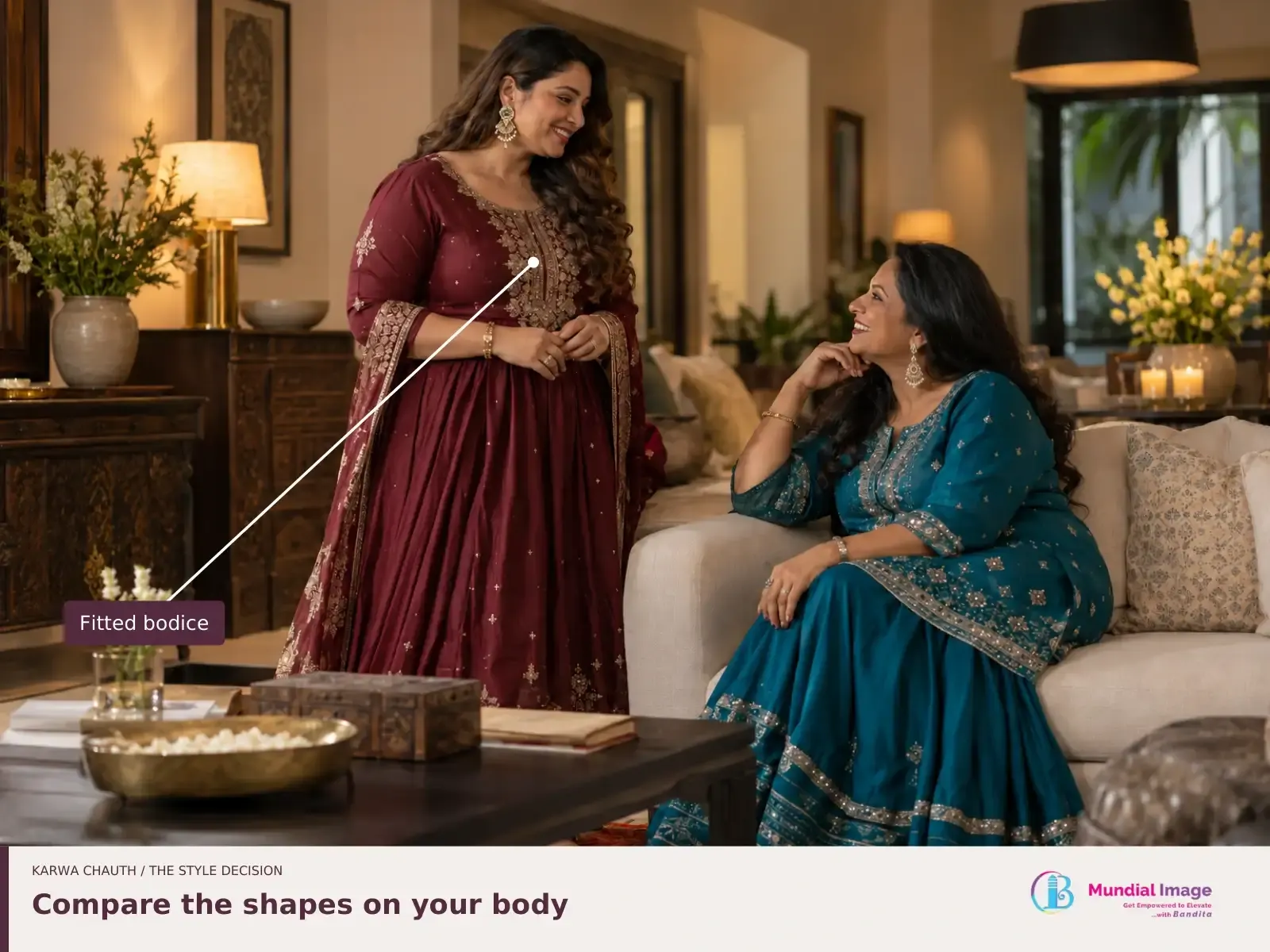
| Decision | Saree | Suit / anarkali / sharara | Lehenga |
|---|---|---|---|
| Comfort | Depends on blouse, support layer and tying | Depends on armhole, lining and trouser waist | Depends on waistband, lining and skirt weight |
| Movement | Practise stride in the chosen drape | Check trouser width and long hems | Check flare through doorways and on stairs |
| Sitting | Pleats and waist need room | Narrow trousers or a fitted bodice can restrict | Spread the skirt without pulling the waistband |
| Weight | Border and pallu can dominate | Embroidery and layered lining add weight | Skirt structure can add substantial weight |
| Drape management | Pallu and pleats need a plan | Dupatta may be optional for your look or required by custom | Dupatta position changes balance |
| Jewellery | Blouse and pallu frame the face | Embroidered yokes may already fill the neckline | Bodice detail decides available space |
| Formality | A plain drape and a rich weave read differently | Construction and finish matter more than the label | Separate pieces can be styled with varying richness |
| Photographs | Pallu gives shape; check face visibility | Neckline and sleeve details stay prominent | A full-length frame shows the skirt best |
| Wardrobe reuse | Change blouse, jewellery or drape | Change dupatta or trousers if proportions work | Reuse skirt, blouse or dupatta separately |
| Styling flexibility | Good if the drape is familiar | Easy to vary through layers and accessories | Strong separates potential; fit must be reassessed |
Try your strongest two options seated, with all layers on.
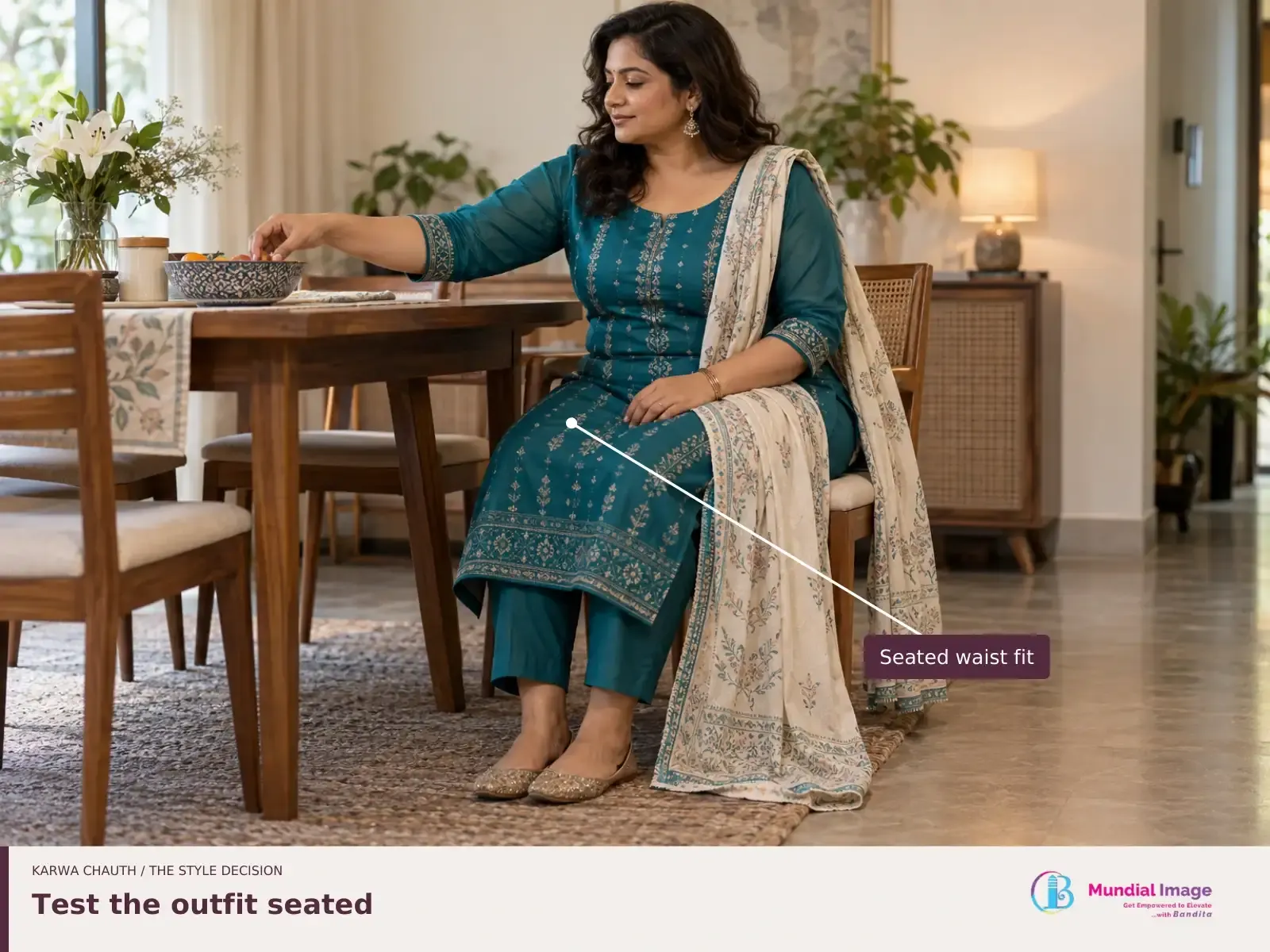
Try the strongest two options seated, not just in front of a mirror. The outfit that needs continuous correction during a ten-minute rehearsal needs work before it earns a place in the evening.
04The saree route2 min
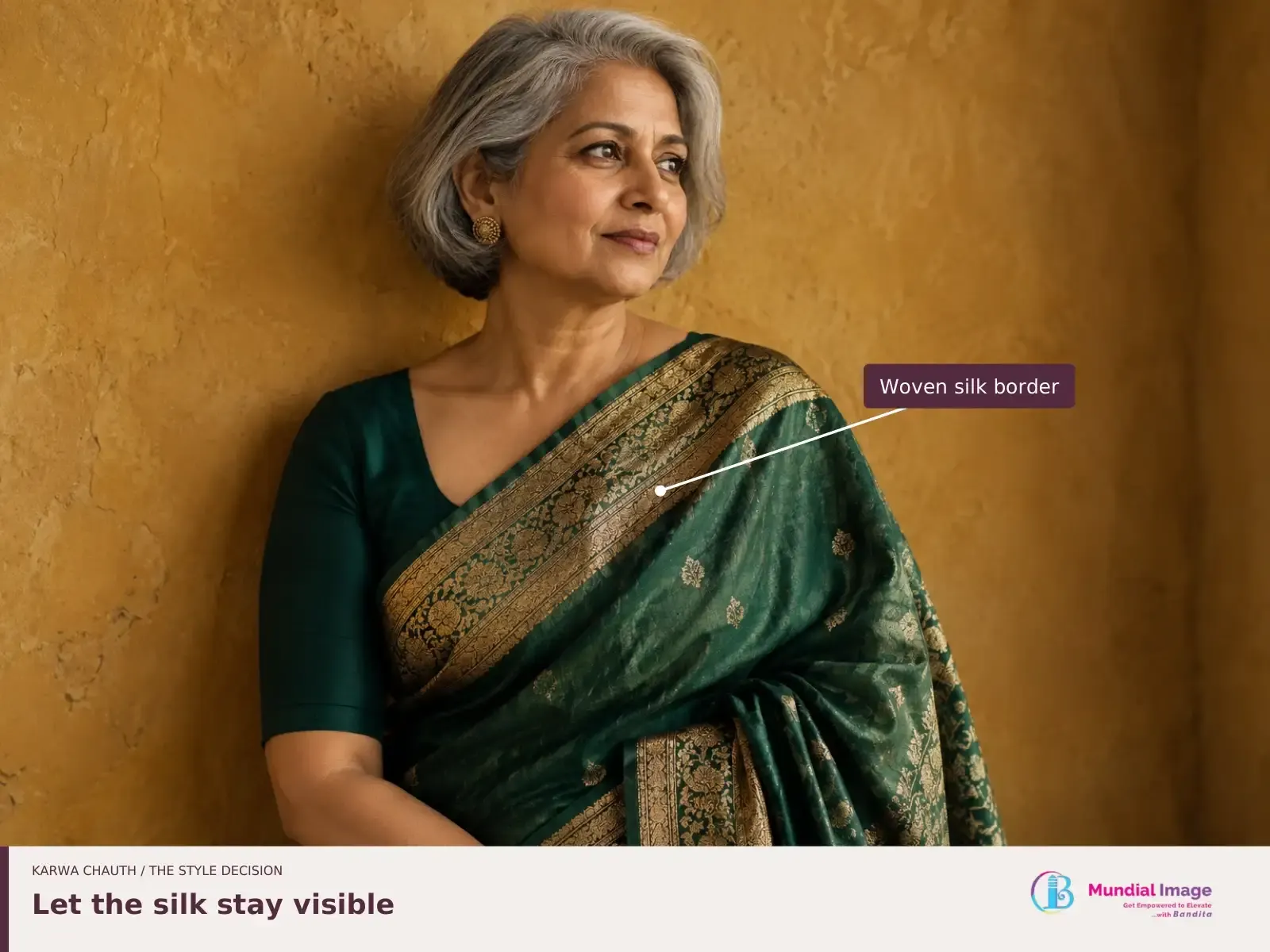
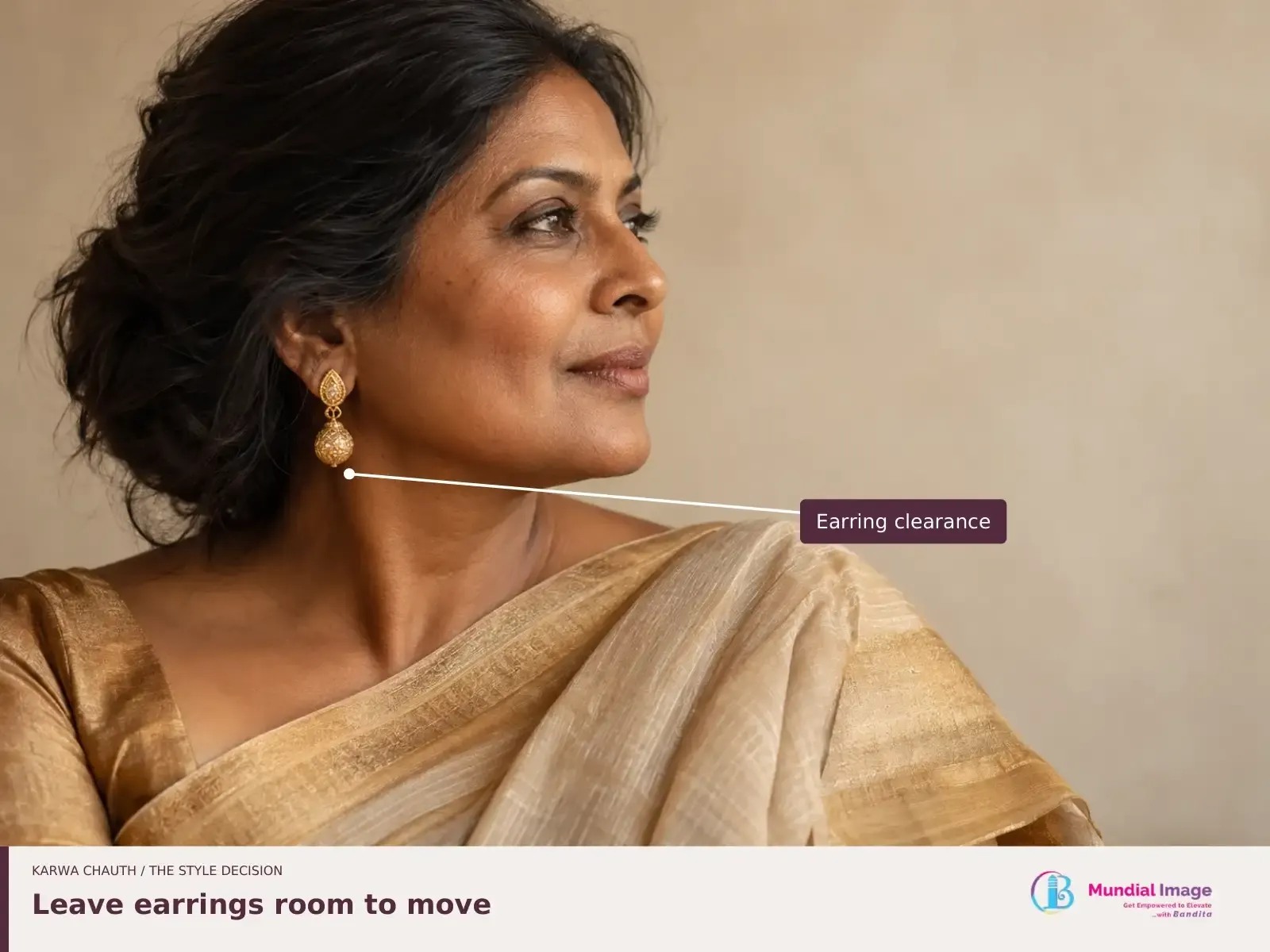
A richly woven silk saree already has detail. Begin with a blouse that fits cleanly and earrings whose lower edge clears the shoulder.
Add a necklace only after seeing the pallu, neckline and earrings together. Silk is a fibre category, not a promise of comfort: check the particular weave, finish, border and blouse lining.
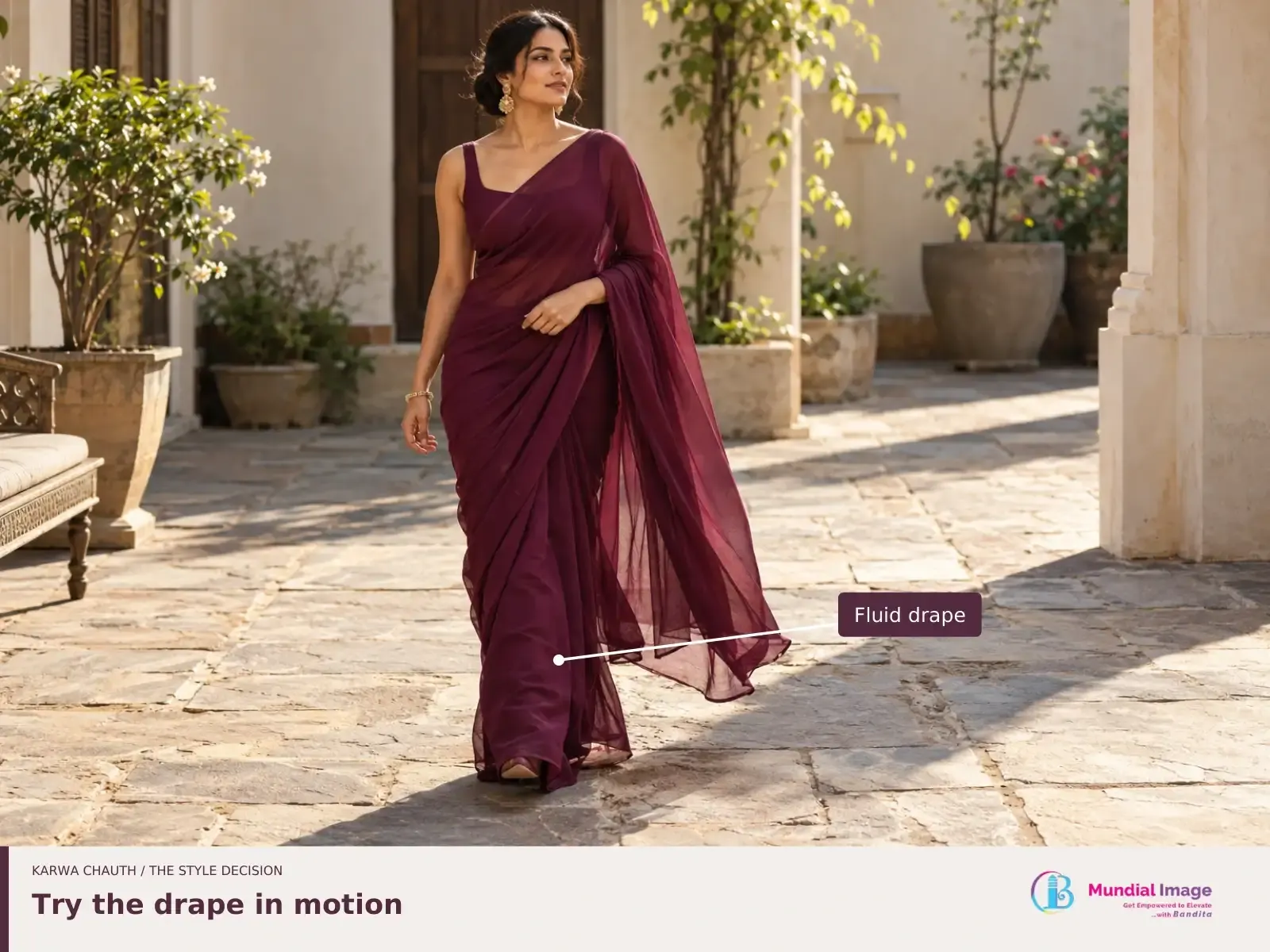
A fluid saree can suit someone who likes movement and a closer fall. Check transparency against the light and test how the support layer behaves when walking.
A heavily embellished georgette saree may weigh more than a relatively plain silk one. Judge the garment in your hands.
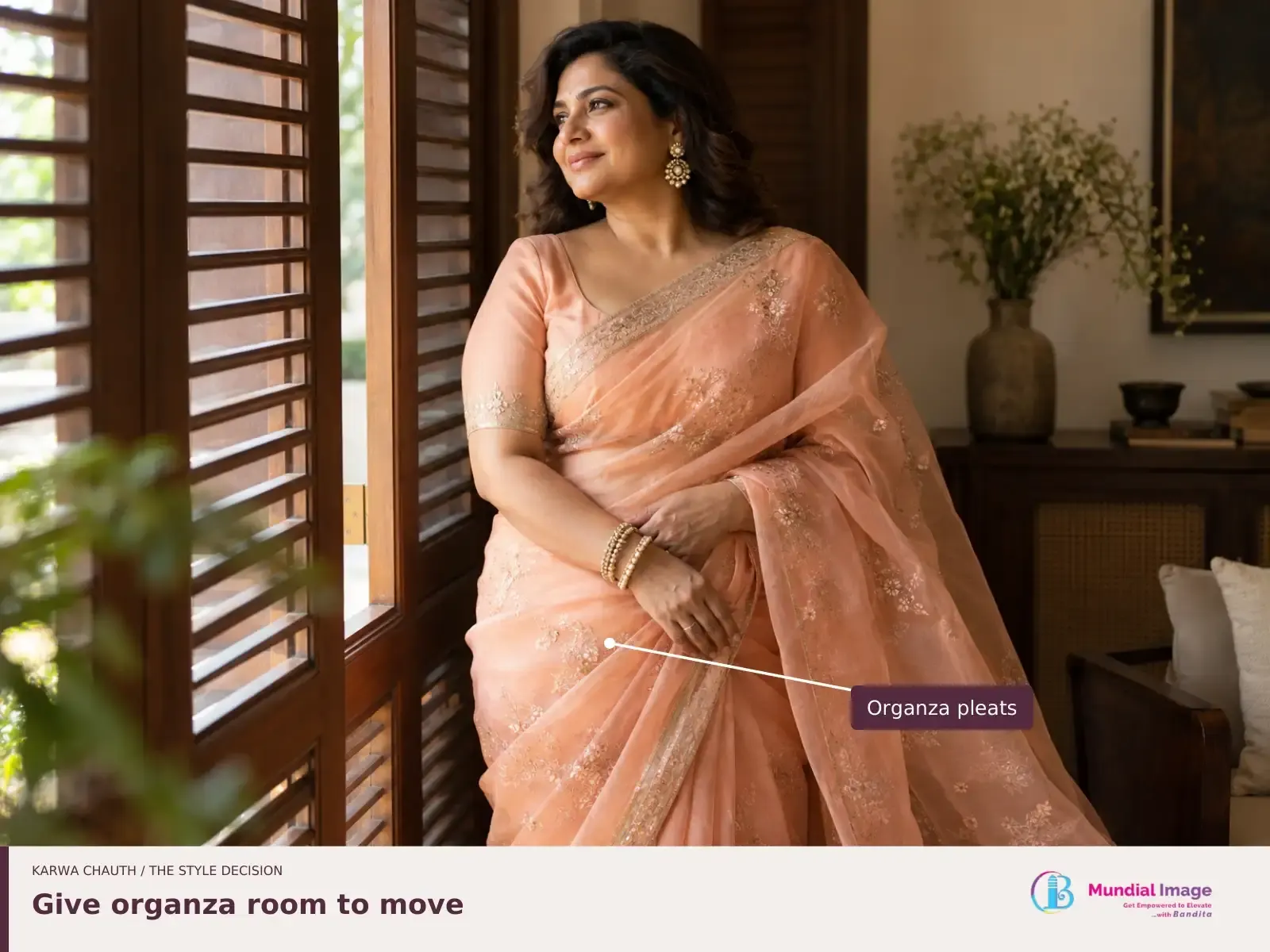
Organza can hold an airy shape and show a border beautifully. It can also spring away from the body and need more management at the pleats. Try the complete drape before committing.
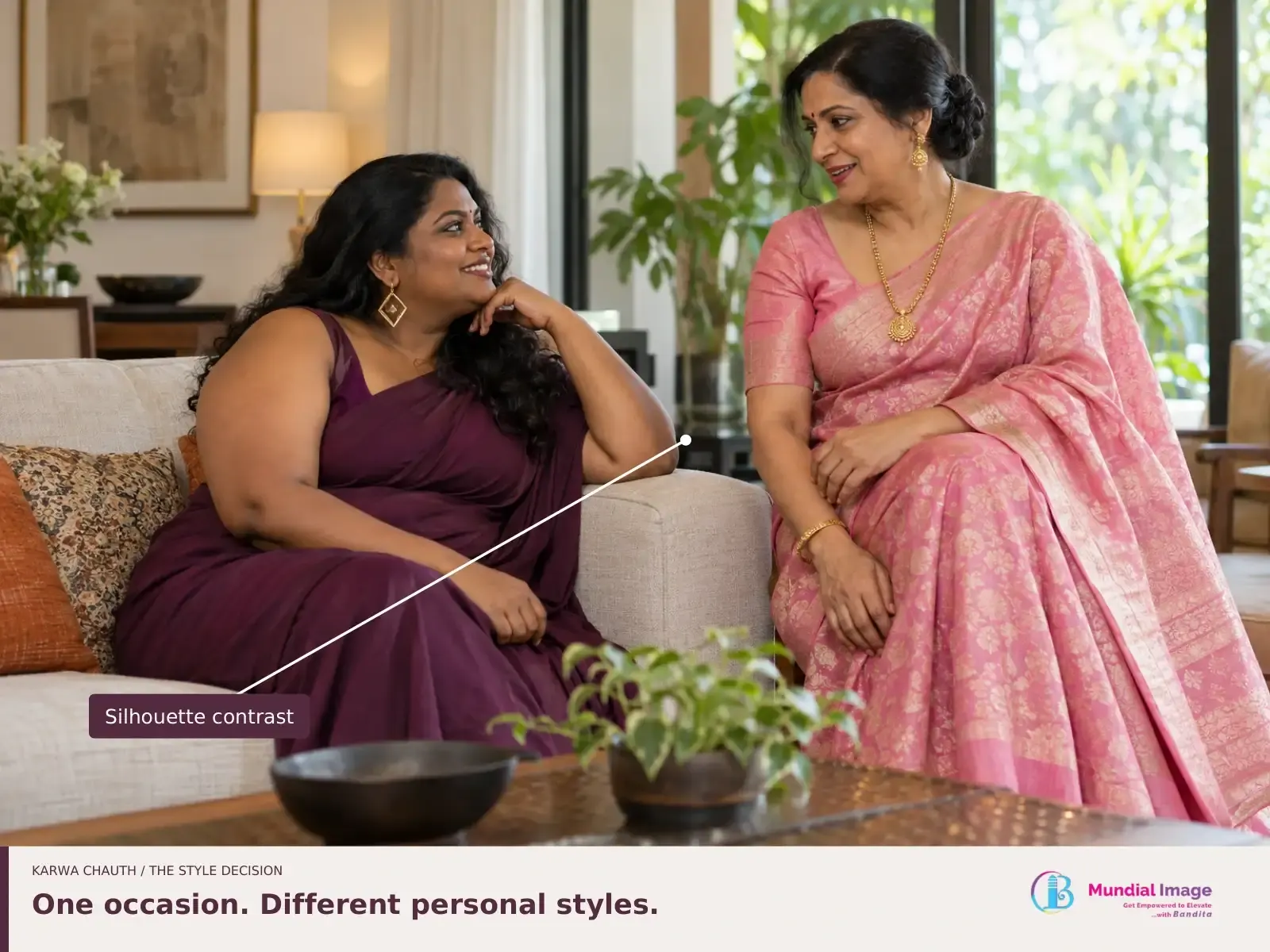
A smooth blouse and restrained accessories give the fabric's structure room to show; this is a styling option, not a body-shape rule.
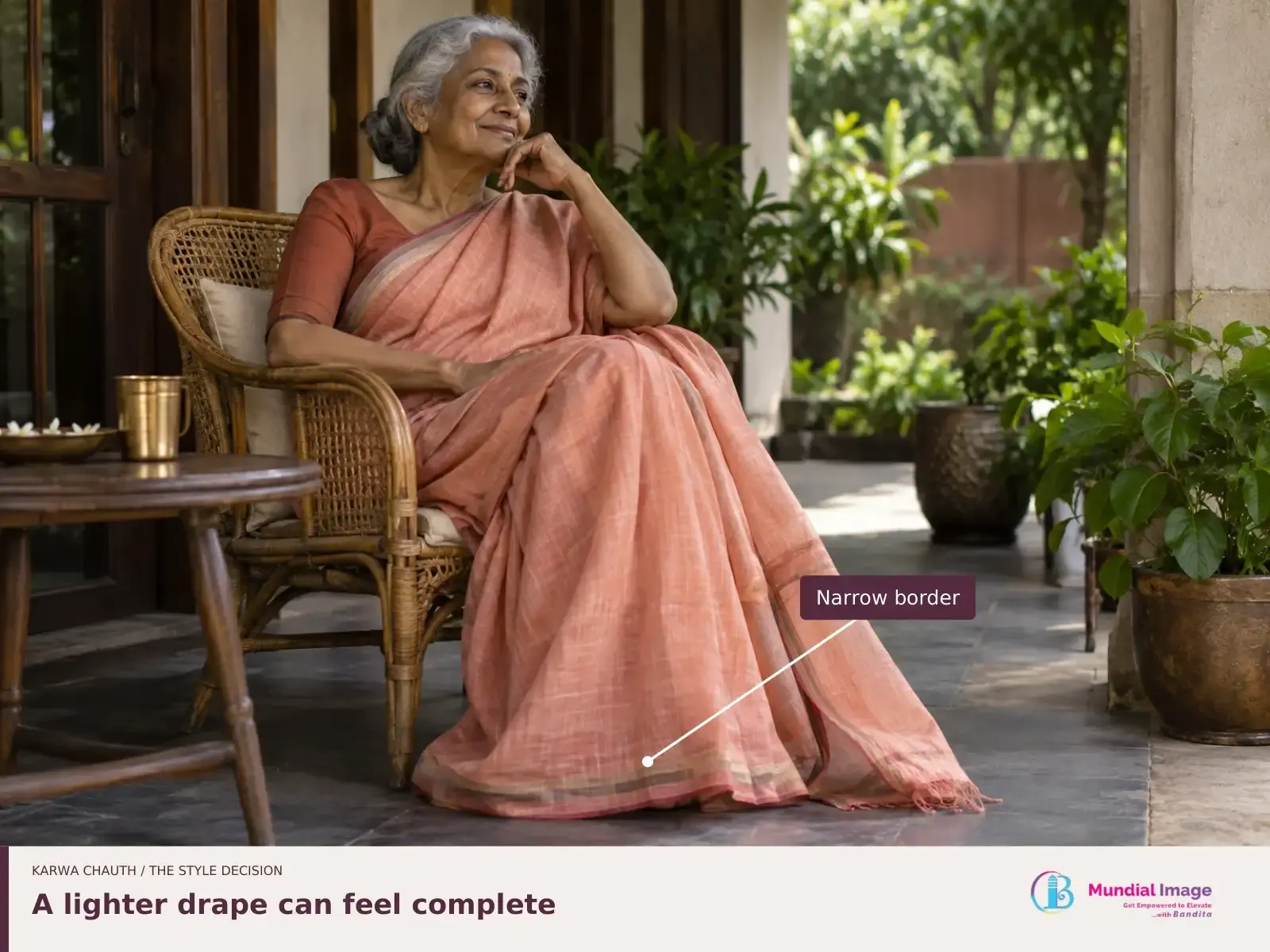
Look for a saree whose pallu stays where you place it, with a blouse you have already worn comfortably.
A narrow border and a pair of sculptural earrings can make a complete festive composition. “Light” should describe the experience of wearing it, not just the product listing.
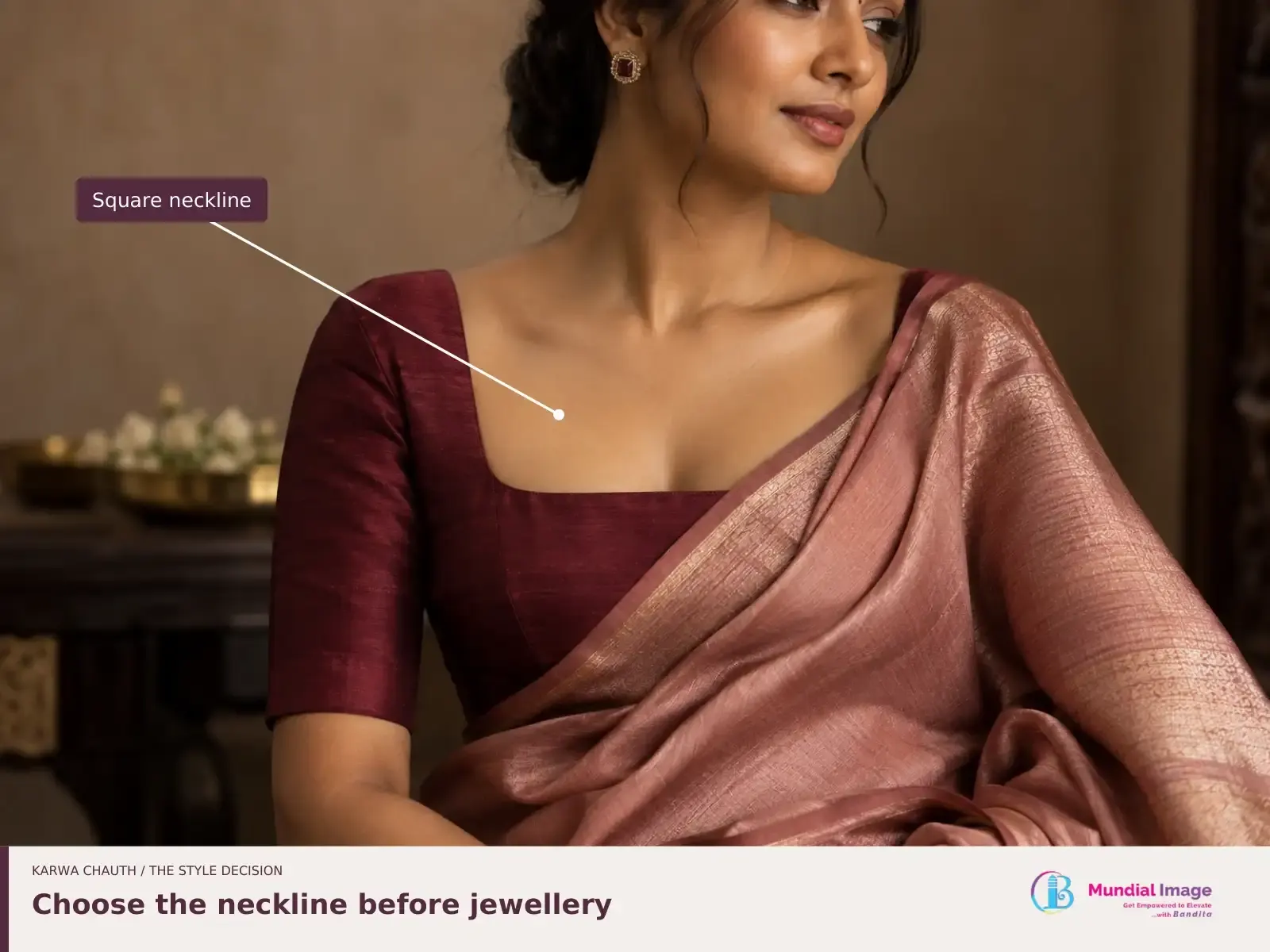
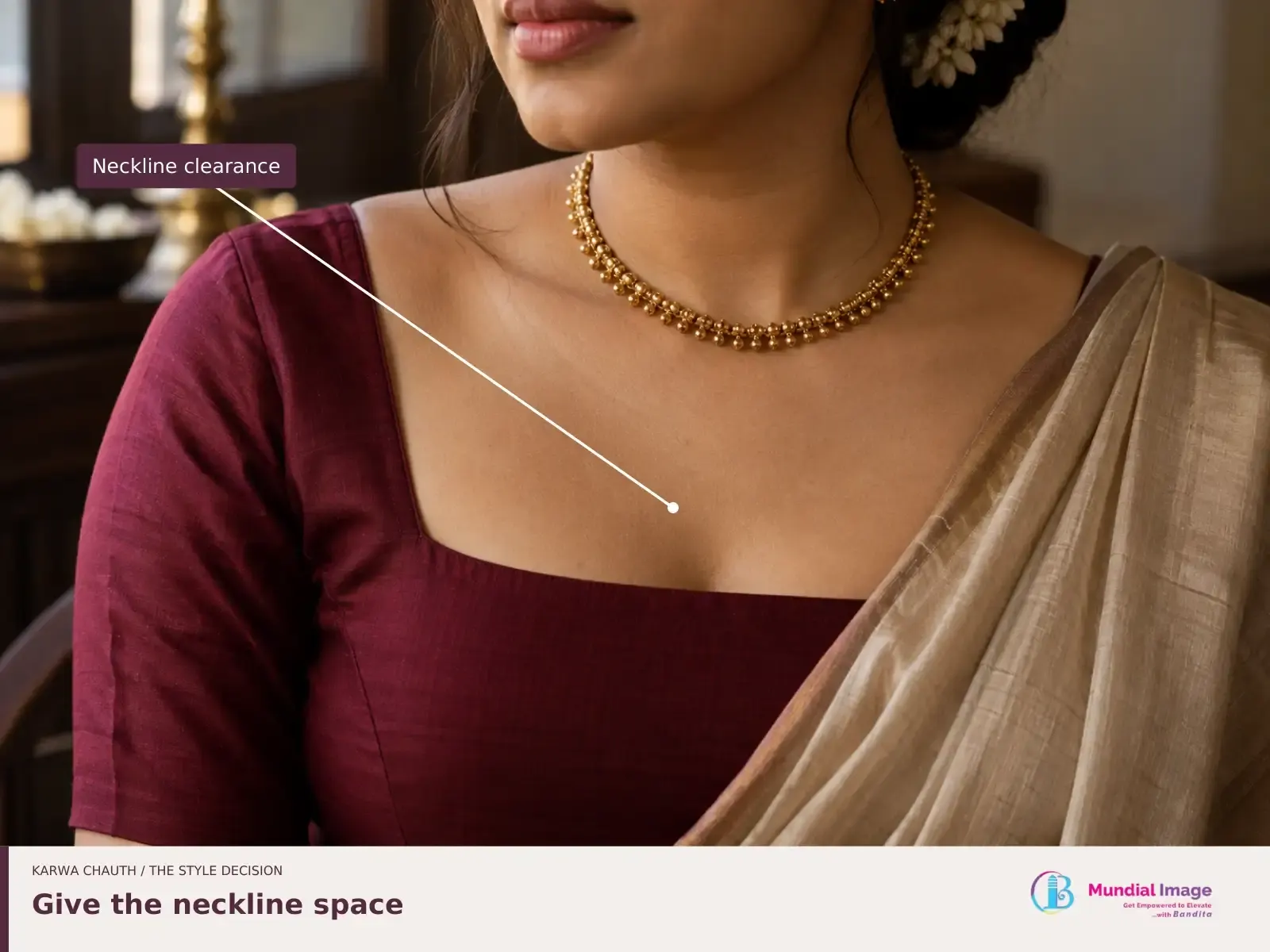
A square neck can expose a clear space for a necklace. A high neck can shift attention to earrings. Elbow sleeves change how much wrist jewellery is visible.
Before ordering a new blouse, pin a piece of fabric across the existing neckline to explore the visual effect, then discuss construction with the tailor. Do not rely on a neckline sketch to establish fit.
05The suit route1 min
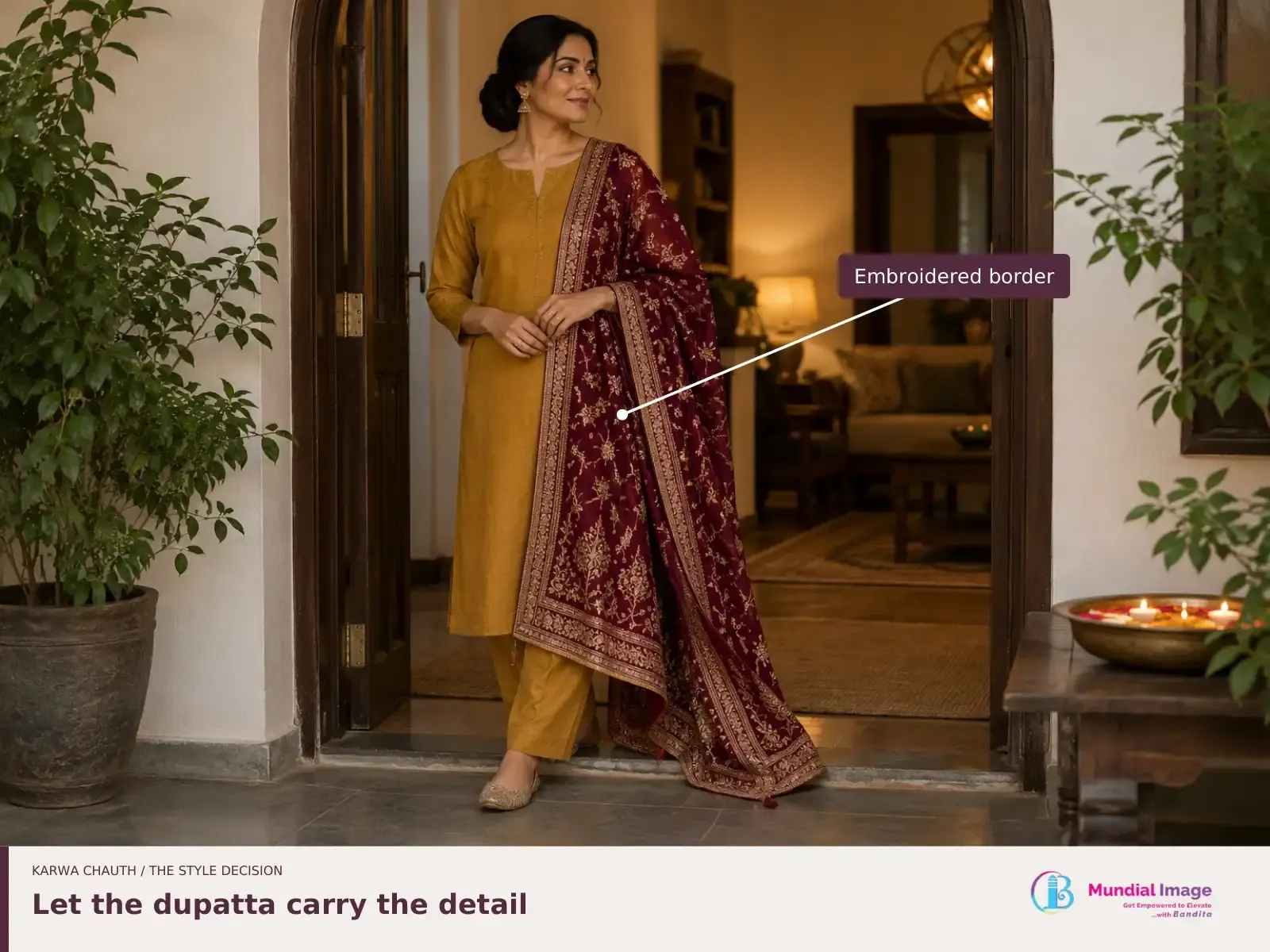
A straight suit with a detailed dupatta is useful when the dupatta is the piece you want people to notice. Keep the neckline comparatively simple and check whether the border catches on earrings.
If the suit already has an embellished yoke, a second heavy border across the chest can obscure both.
An anarkali offers movement through the skirt, but its fitted upper half still needs checking. Sit down, lift both arms and reach forward. Make sure the waist seam stays comfortable and the underlayer does not ride up. With a long hem, set the length using the footwear you will actually wear.
A sharara brings volume at the lower leg. Walk through a doorway and climb a step in it. A shorter kurta can reveal the change in shape; a longer one creates a different proportion. Neither is universally more flattering. Look at the full outfit, including the dupatta, before deciding.
A festive co-ord can work when it fits your observance and style. Give a simple set one deliberate finish: a treasured necklace, a worked jacket or an embroidered dupatta. Check whether additional layers make the outfit harder to wear. A co-ord does not require extra ornament simply to justify being at the celebration.
06Rewear1 min
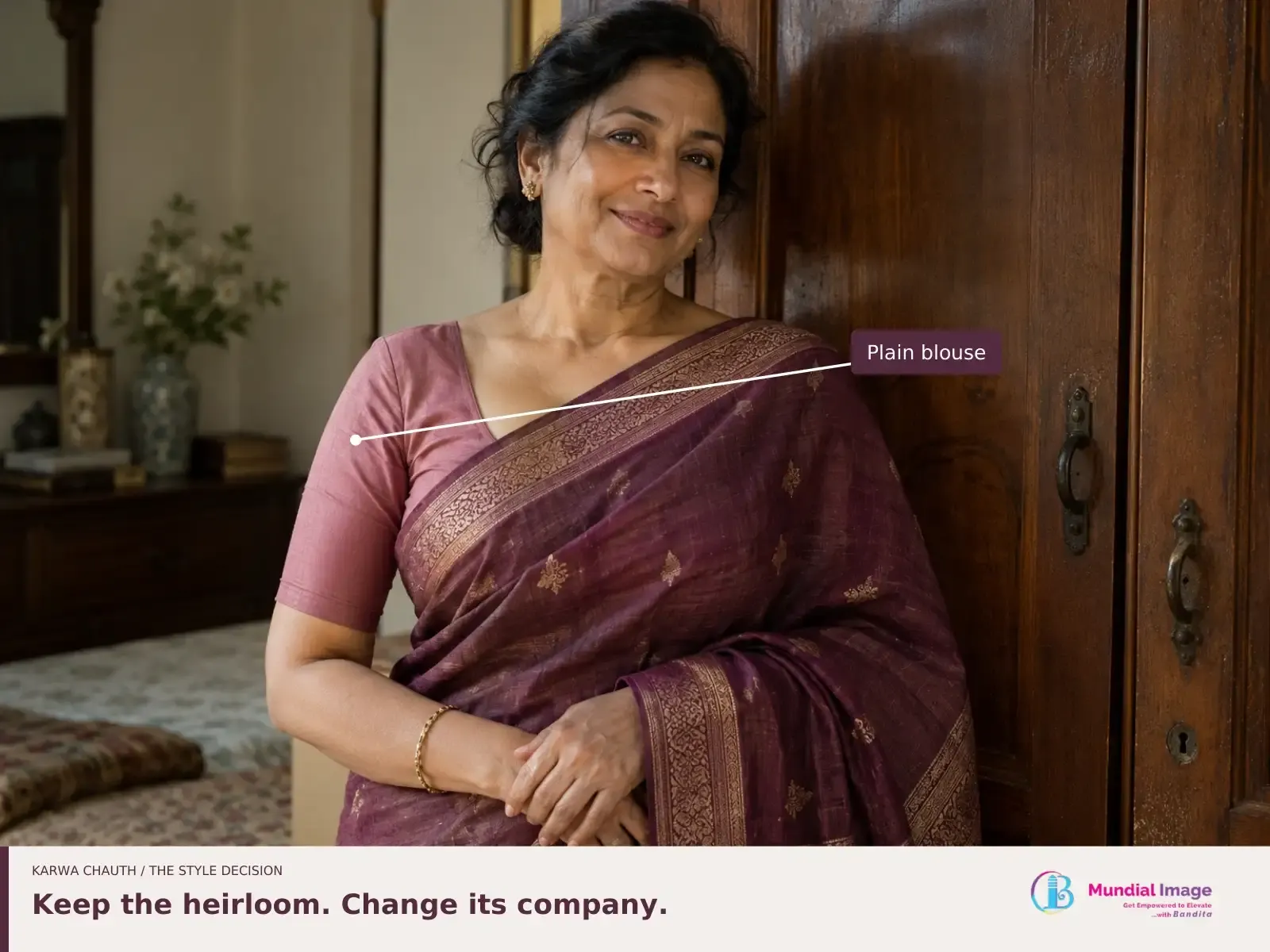
Start by choosing what matters about the original outfit. It might be the weave your mother selected, the border, or the colour you wore at the wedding.
Keep that feature visible while changing the pieces around it.
Recheck present-day fit and condition before making a plan.
| Piece to rewear | A different combination | What to check |
|---|---|---|
| Wedding saree | Plain blouse, familiar earrings, a simpler hair arrangement | Present-day blouse fit and condition of the saree |
| Wedding blouse | Plain saree or a compatible skirt | Closure, armhole movement and proportion |
| Embroidered dupatta | Unembellished suit in a colour drawn from the border | Shoulder weight, head-covering fit if needed, snagging |
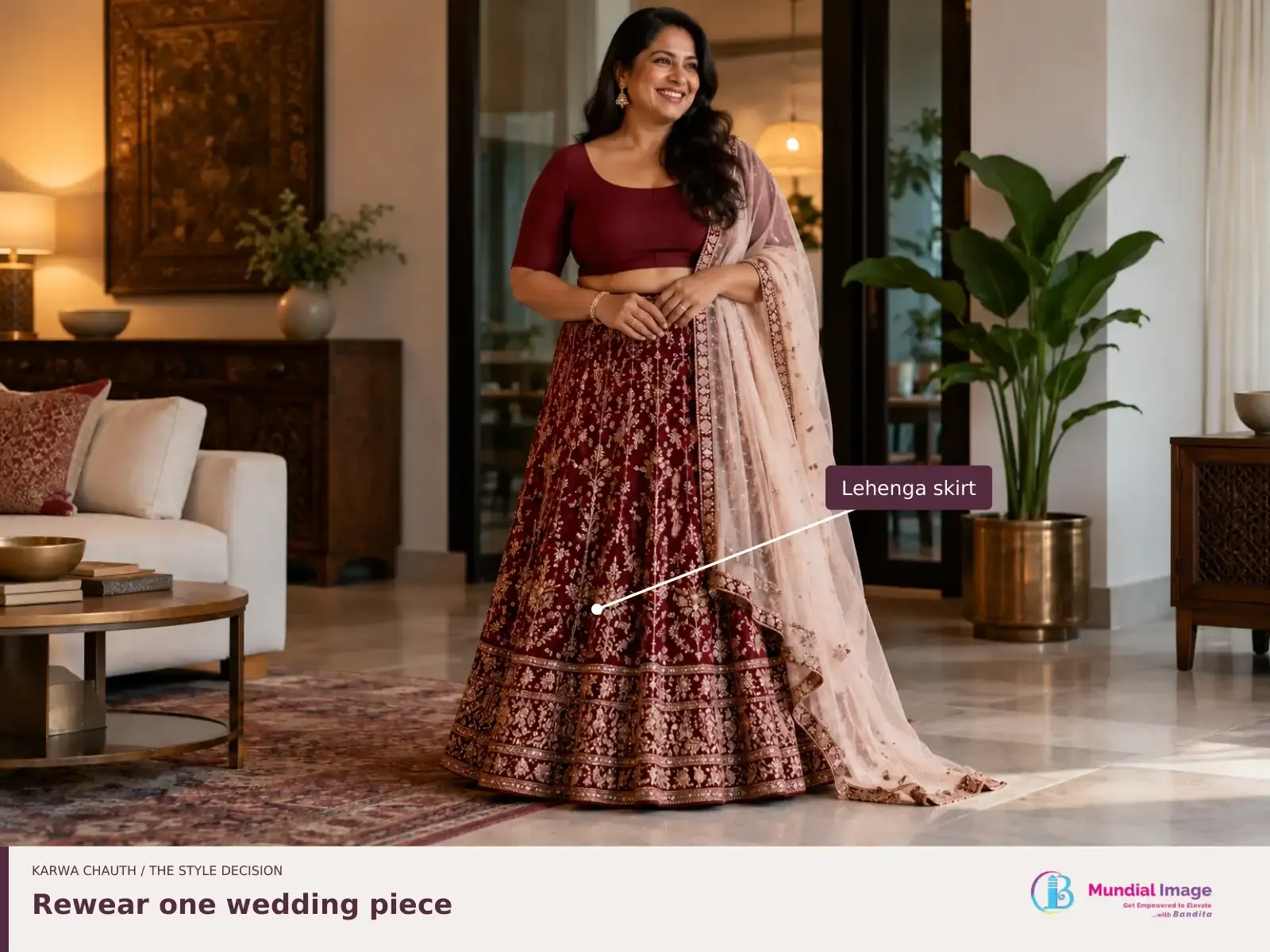
| Lehenga skirt | Plain blouse with a lighter dupatta | Waistband, skirt lining and hem |
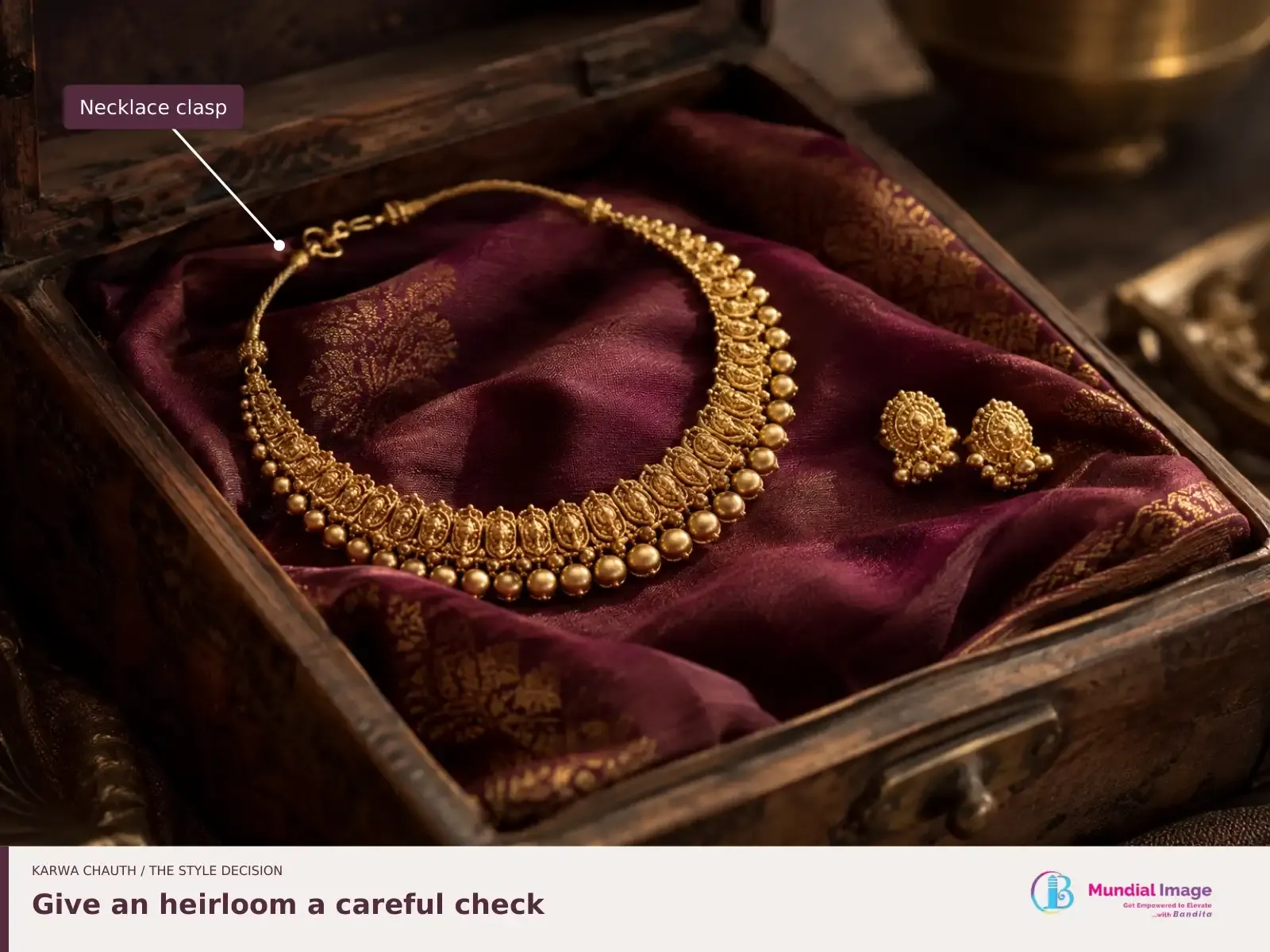
| Family necklace | Simple neckline and compact earrings | Clasp, thread, stone settings and comfortable placement |
A lehenga skirt with a quieter blouse still feels festive because the skirt retains its presence. Removing one layer of bridal jewellery may be enough.
There is no obligation to make a cherished wedding outfit look unrecognisable.
Lay borrowed heirloom pieces out with their owner. Ask before altering a clasp, polishing a finish or pinning a delicate textile.
Inspect the piece early enough to arrange specialist care if needed. A sentimental object deserves a plan that protects it.
Reuse is an option. Fragile pieces may need specialist care.
07Colour2 min
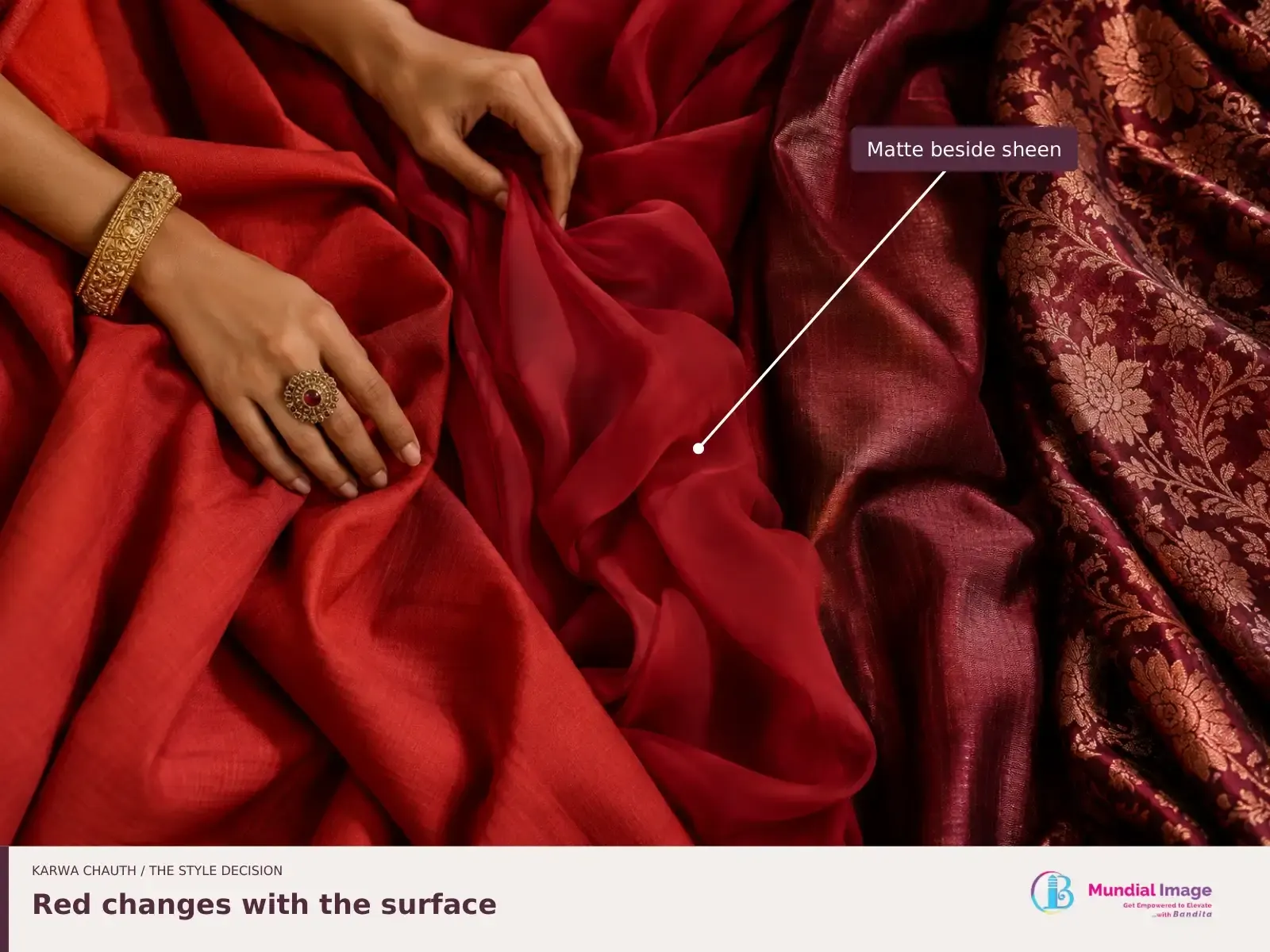
Crimson georgette and crimson brocade can produce very different looks. If red feels repetitive, change the relationship between matte and shine, plain and worked, fitted and fluid.
A matte vermilion-toned suit with a narrow metallic border looks clearer with fewer competing reflective surfaces. A wine saree can take a softer rose blouse or continue in the same deep colour. A bright crimson drape with an embroidered blouse may need only earrings and the bangles you choose to wear.
Illustrative shades. Screen colour is not a fabric match.
Hold two reds beside each other before assuming they match. Warm orange-red and cool blue-red can make an intentional contrast, but a near-match may look accidental if the fabrics have similar finishes. Repeat one shade elsewhere, or separate the two with the blouse or dupatta. See the combination in both daylight and the room where you will dress.
Pink, green, plum, peach, mustard and teal offer different starting points. Whether a colour feels appropriate is a conversation about your household's practice and your preference.
Avoid treating a retail colour chart as religious authority.
Styling examples, not religious rules or complexion categories.
Antique-gold finish with a quieter blouse
Assess: strong colour, contained shineRose accents or pearl details
Assess: contrast near the faceTonal blouse with one clear-metal accent
Assess: depth without many competing coloursA slightly deeper border and defined lip
Assess: whether pale layers remain distinct in the lightWine detailing and small gold-finish earrings
Assess: a warm palette with a darker anchorCopper-toned detailing or a tonal dupatta
Assess: the warmth of the metal against the clothThese are illustrative combinations, not complexion categories. Try fabric beside your own face. There is no need to lighten skin, conceal age or meet a particular body ideal to make a festive colour work.
08The first year2 min
The first year can bring several opinions at once: a gift from family, a wedding outfit waiting to be reworn, pictures saved online, and your own idea of how you would like to look. Separate those decisions before shopping.
Ask what the day actually involves. Is there a gathering or a quiet evening? Does your family have a particular expectation about a dupatta, bangles or colour? Which details matter to you? A direct conversation is more useful than trying to infer a rule from everyone else's photographs.
Make a short list of pieces you are choosing to retain. A gifted bangle set might stay while the outfit remains simple. A wedding saree might be important while the original necklace set is not. If a customary piece is part of your observance, build the surrounding look around it; do not describe it as clutter to be removed.
Then set a spending boundary. Check what already fits, what can be borrowed and what needs alteration. Buy the missing element only after seeing the full combination. An inexpensive new blouse that fits may contribute more than a second elaborate outfit. Conversely, alteration can be impractical if the old garment has too little seam allowance or fragile fabric. Reuse is an option, not a test of virtue.
The first celebration does not require a new bridal outfit.
A gathering or a quiet evening, and any family expectation about a dupatta, bangles or colour.
A gifted bangle set, a wedding saree, a customary piece. Build around them.
Check what fits, what can be borrowed and what needs alteration.
After seeing the full combination. A blouse that fits may do more than a second outfit.
Underlayers, shoes, jewellery and the head covering, if that is part of your practice.
Leave time for a rehearsal. Wear the planned underlayers, shoes and jewellery together. Try the head covering if that is part of your practice. Arrange help with unfamiliar draping before the day, rather than relying on someone to be free at the last minute.
Photographs can carry a memory without reproducing a bridal portrait. You can choose a richly dressed look, a quieter one or something in between. The useful question is whether the finished outfit feels like a choice you made. If advice from several people conflicts, return to the details you agreed mattered and decide the remaining pieces yourself.
09Jewellery3 min
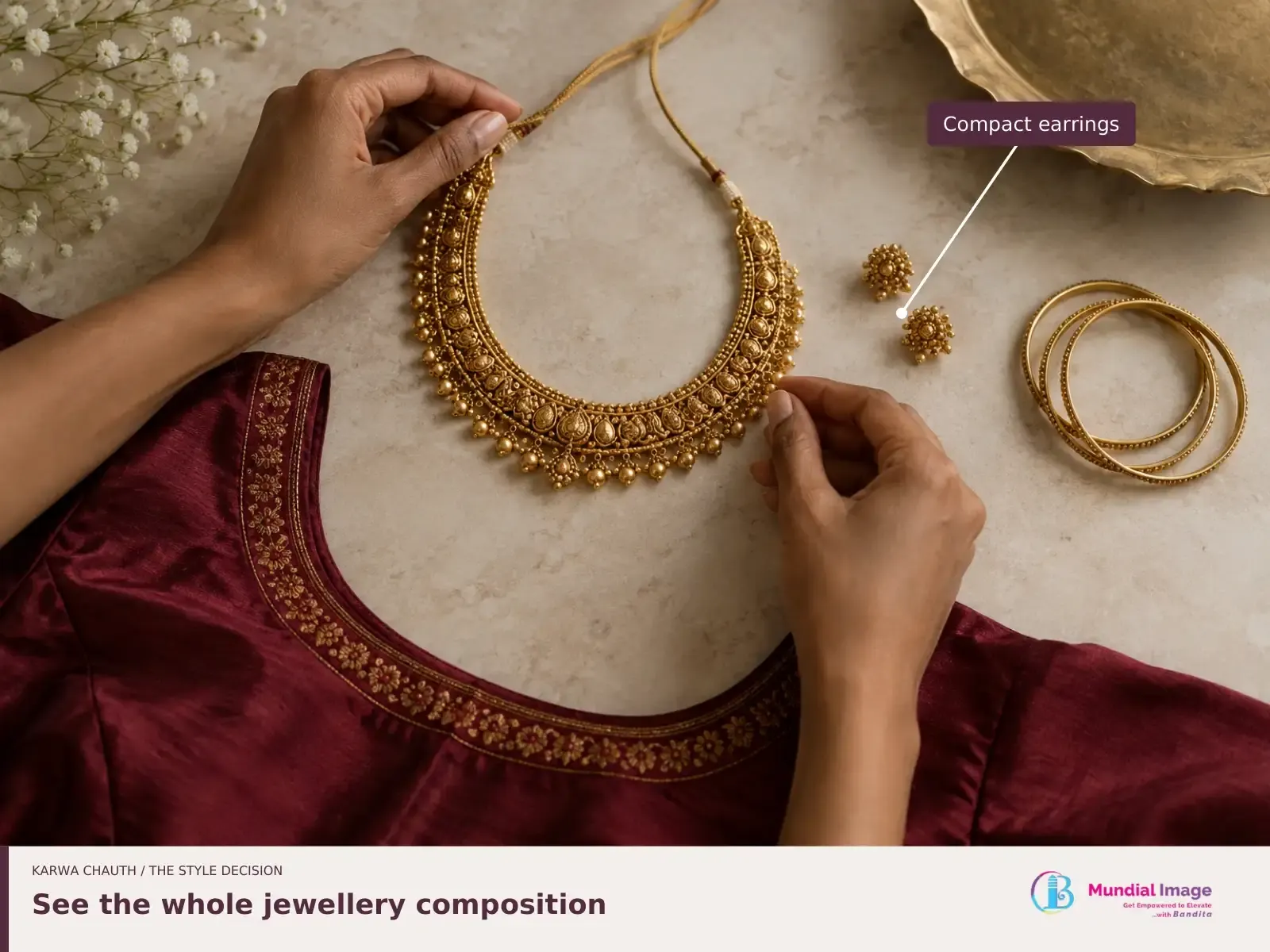
Lay the blouse flat with the necklace above it. This is a useful first check, but finish on the body: a necklace changes position when worn, and a pallu can cover the space you thought was available.
An intentional layered shape can also work. Check its position.
| Neckline or detail | Starting option | Check on the body |
|---|---|---|
| Open scoop or square neck | Short necklace contained within the opening | Does it sit clear of the fabric edge? |
| V-neck | Pendant that follows the opening, or a deliberate shorter contrast | Does the pendant collide with the point? |
| High or heavily worked neckline | Earrings with little or no additional neck jewellery | Is the embroidery visible? |
| Boat neck | Earrings, or a longer necklace placed deliberately over plain fabric | Does the chain slide or snag? |
| Dense pallu near one shoulder | Compact earrings or a controlled drop | Turn both ways and check clearance |
There is no requirement to leave the neck bare with a high blouse. A long necklace over a plain high neck can be beautiful. The distinction is between a deliberate layered shape and jewellery hovering awkwardly on the same line as an embroidered edge.
A broad, hollow earring can look prominent yet feel light. A small solid piece can feel heavy. Assess appearance in the mirror and wearability during a rehearsal. Never infer comfort from a photograph.
With large earrings, first try the look without a necklace. With an important necklace, start with compact earrings. If a maang tikka is part of the look, try it with the actual parting and head covering. These are ways to make a decision, not a compulsory “one statement piece” formula. Several rich pieces can work together when their scale, spacing and comfort have been considered.
Try itJewellery weight balance
Qualitative decision aid. No measurements or scores are implied.
Open space. One rich piece near the face will read clearly.
A clear lead. Start the other pieces compact.
Two leads. Check their spacing in the mirror, then during a rehearsal.
A full face area. Several rich pieces can work. Check scale, spacing and comfort before adding more.
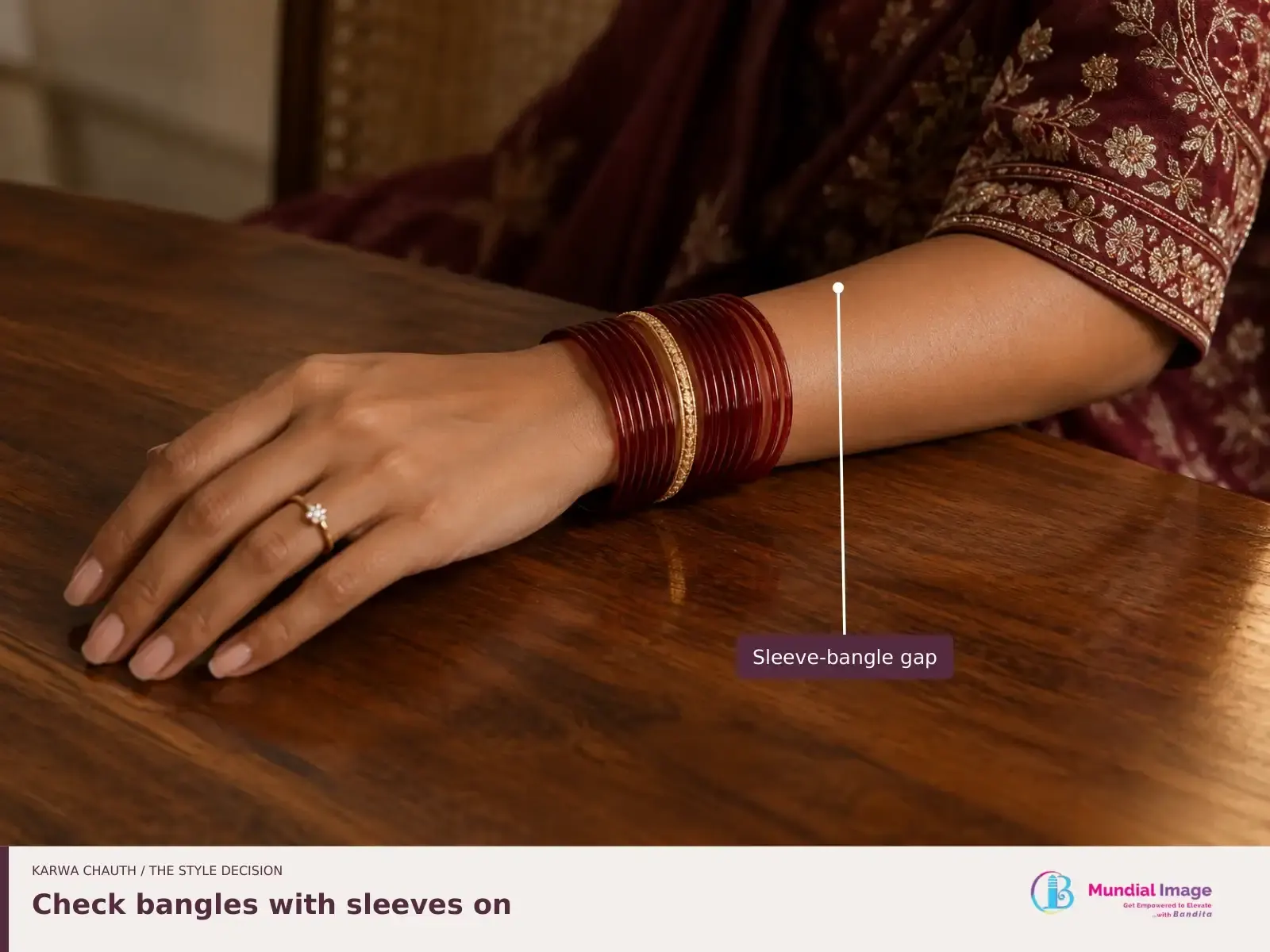
Bangles: put on the complete sleeve and check the wrist while holding a phone or plate.
An embellished cuff and a wide stack may rub or hide each other. Put on the complete sleeve and check the wrist while holding a phone or plate. Choose rings that do not catch the textile.
Keep personally meaningful or customary pieces in the composition, then decide how much additional ornament is useful.
10Hair and makeup2 min
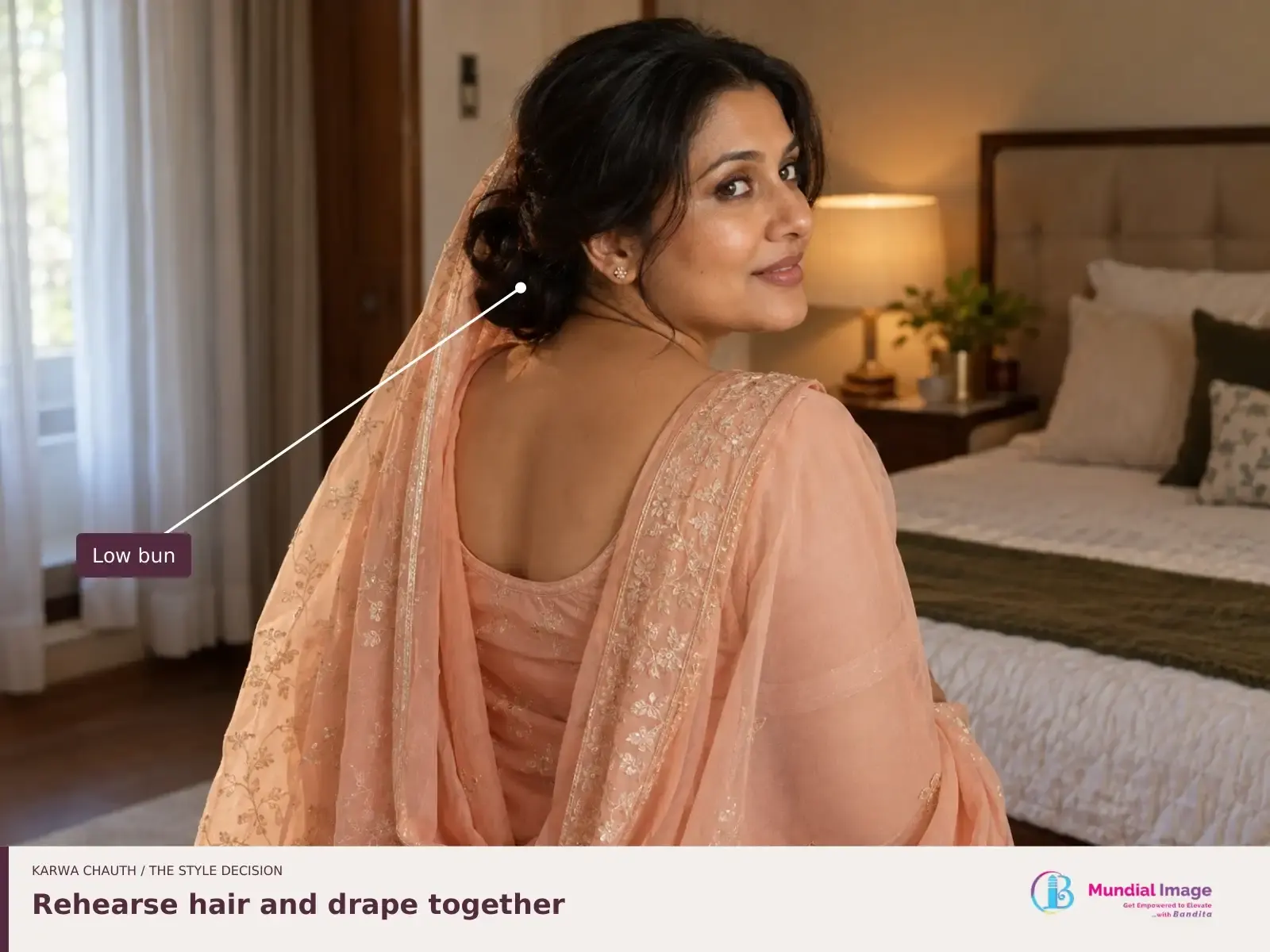
A low bun leaves the neck and earrings visible, but its position matters if a dupatta will cover the head. Place the fabric first during the trial; check that it does not drag on the bun or pull the parting. A softer arrangement can still be secure.
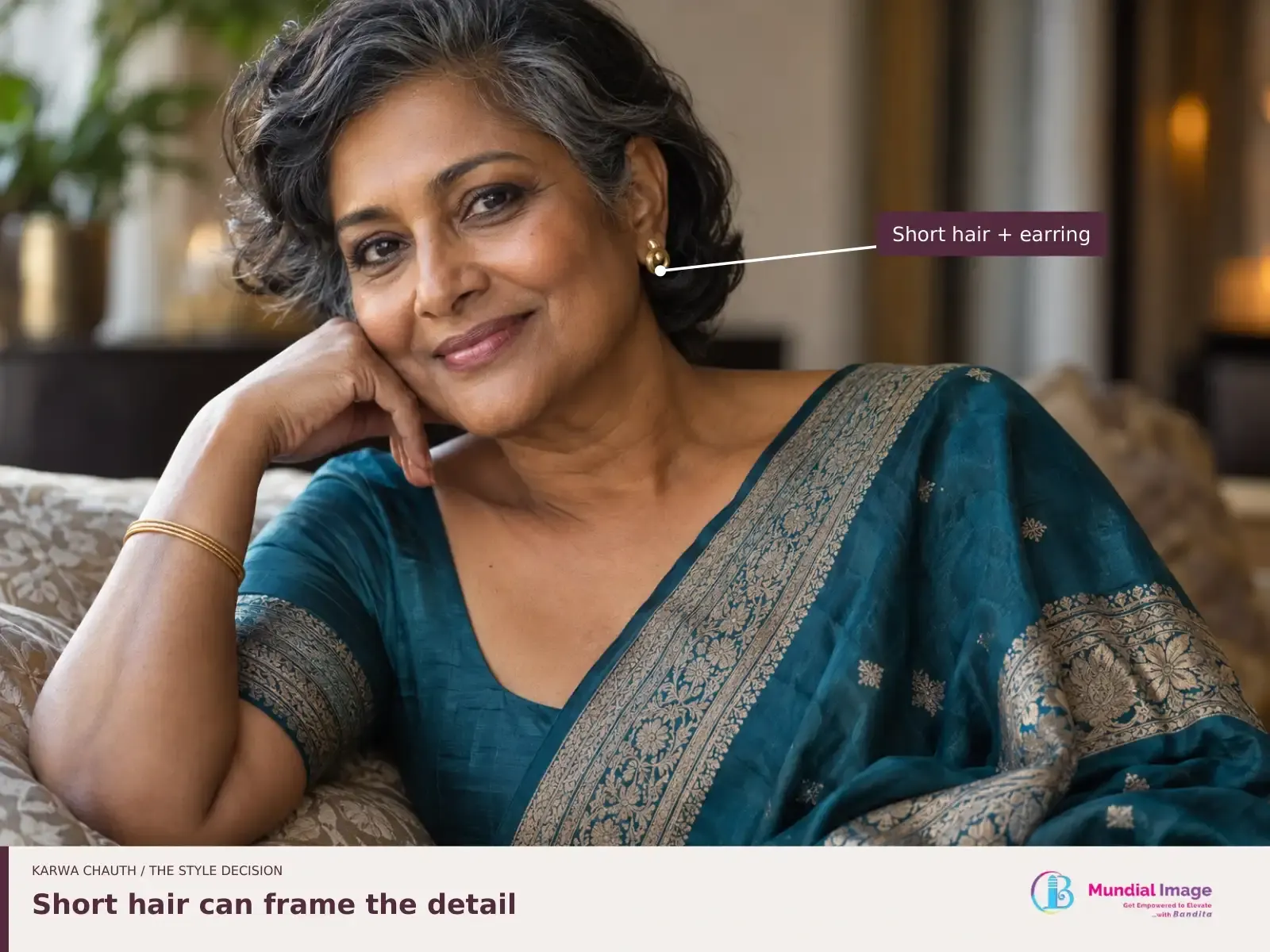
Half-up hair can keep strands away from the face while retaining movement. Short hair can be tucked on one side or held with a small accessory if desired. A braid offers another route, but check its path against the necklace clasp and embroidered back. Hair does not need extensions or flowers to look finished.
A polished style should not need painful tension.
| Hair | What it does | Check with earrings on |
|---|---|---|
| Low bun | Leaves the neck and earrings visible | Dupatta does not drag on the bun or pull the parting |
| Half-up | Keeps strands from the face, keeps movement | Turn your head; no snagging |
| Braid | Another secure route | Its path against the necklace clasp and embroidered back |
| Short hair | Tucked on one side, or a small accessory | Jewellery stays clear and visible |
| Loose hair | Soft and open | Repeated snagging means alter the hair or the earrings |
If wearing loose hair, turn your head with the earrings in place. Repeated snagging is a reason to alter the arrangement or the earrings.
In warm or humid conditions, choose a style you know you can maintain. Avoid a tightly pulled style simply because the reference photo looks polished.
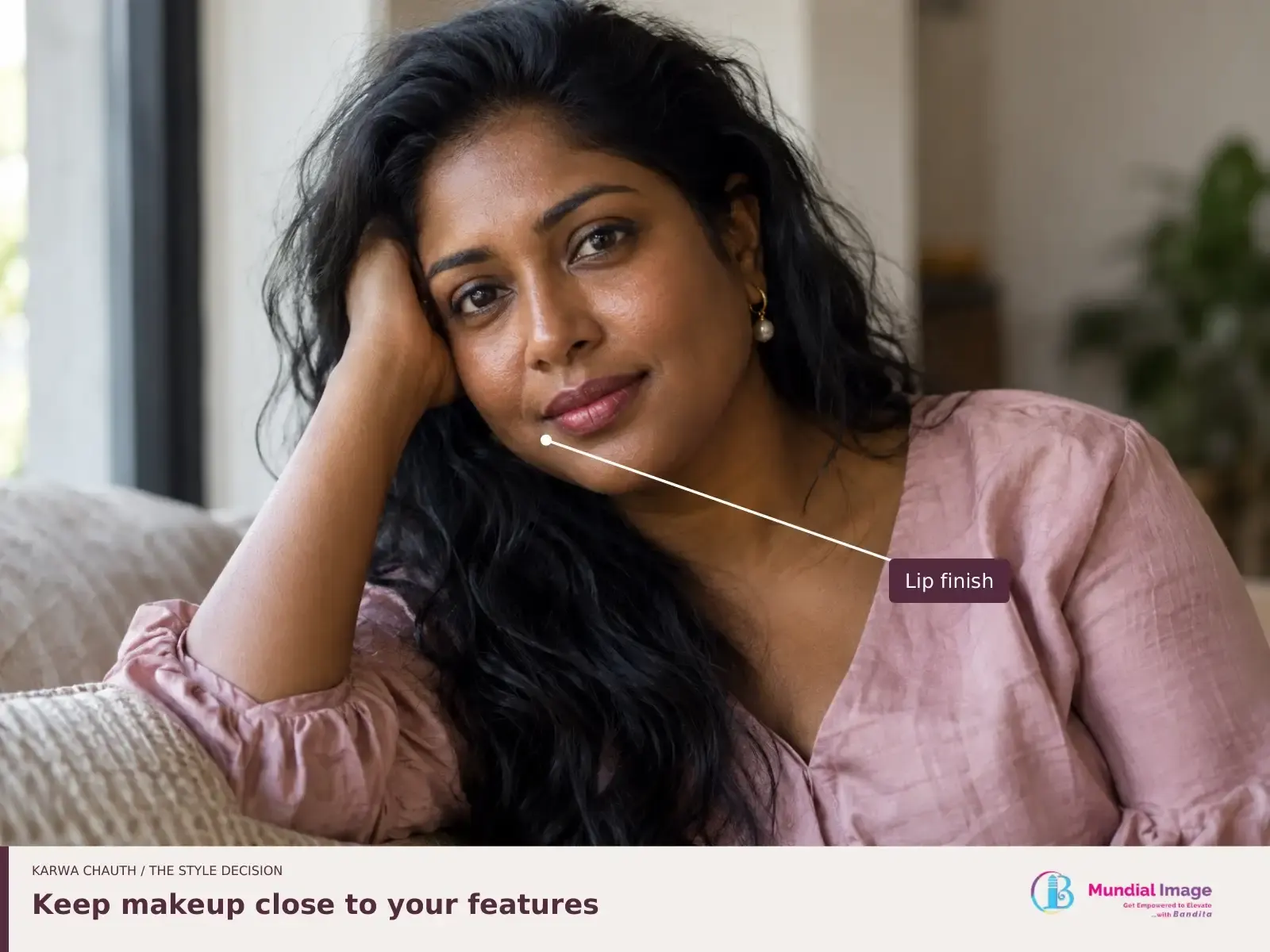
Choose the face you want to see in the photographs before adding intensity everywhere. A defined lip with quieter eyes draws attention differently from a softer lip and stronger eye definition. Neither is mandatory; use your usual preferences as a starting point.
For a long day, familiar products are easier to judge than an entirely new routine. Check makeup in daylight, the puja room and a phone photograph. A reflective finish can look different under direct flash. If you dislike the test result, change the light or the finish before adding more coverage. The objective is to keep features visible, not to change skin tone.
Refresh the areas that need attention before evening photographs. Check the lip edge, any transferred colour, and shine you personally want to reduce.
Long-wear claims are product-specific; this guide cannot promise a particular number of hours.
11Comfort1 min
Run a short rehearsal with every layer on. Sit in the position you expect, reach forward, lift your arms, walk and turn. A standing mirror check misses the waistband, armhole and hem problems that appear in use.
Check the support layer as carefully as the visible garment. A saree can feel restrictive because of its underskirt, a suit because of its lining, and a lehenga because of its closure. Adjust the source of the restriction. Calling an entire garment category uncomfortable does not solve it.
Tap each check as it passes. This is a clothing-fit check, not medical advice about fasting.
Tap each check as it passes.
Adjust the source of the restriction.
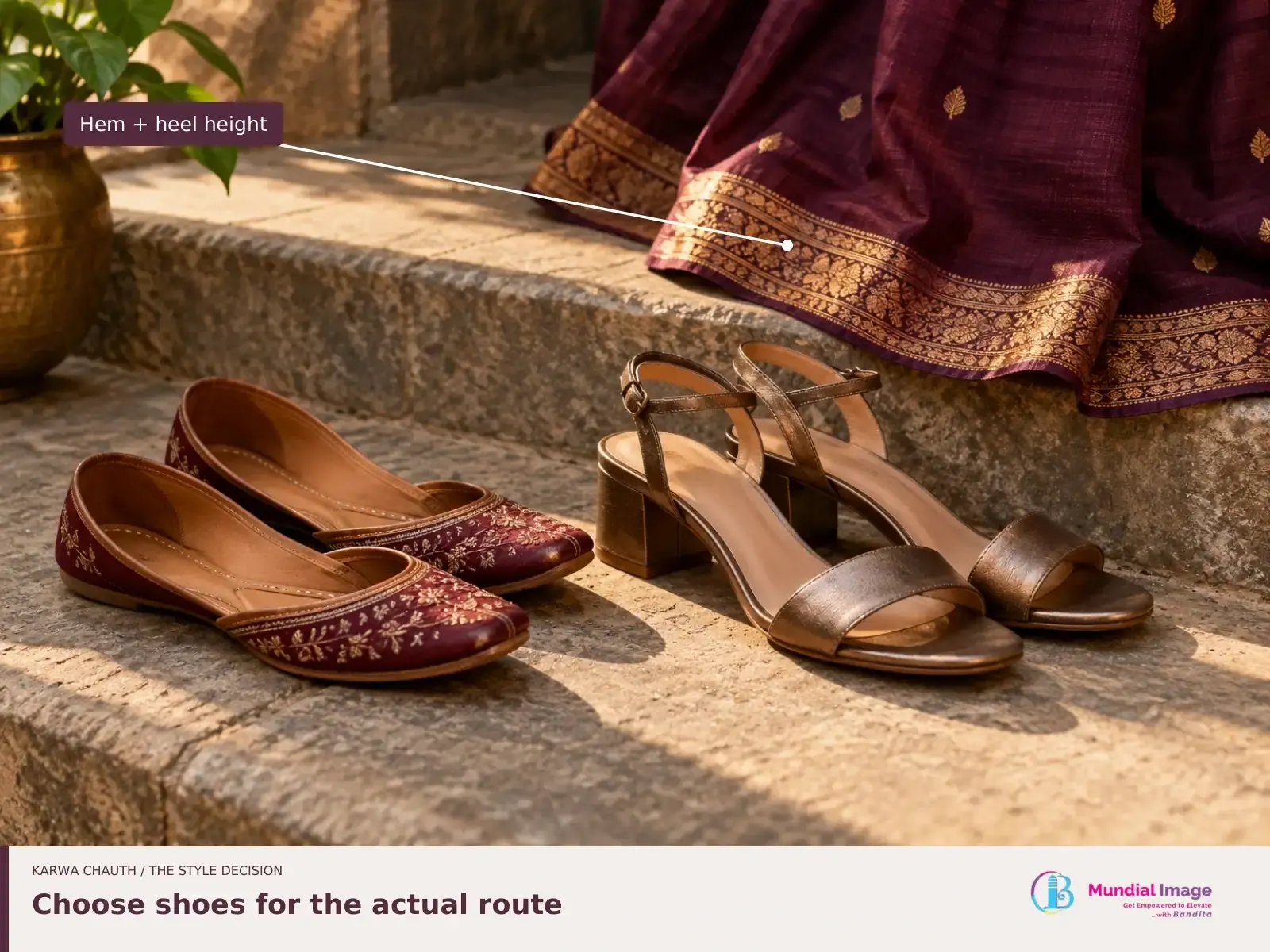
Choose shoes using the actual route. A familiar flat or secure low heel may suit stairs and a terrace, but test grip, fit and hem length yourself. New juttis can rub too.
If changing shoes later, make sure the outfit works at both heights. In cooler weather, plan a layer that does not crush the sleeve or displace the jewellery.
12Moonrise1 min
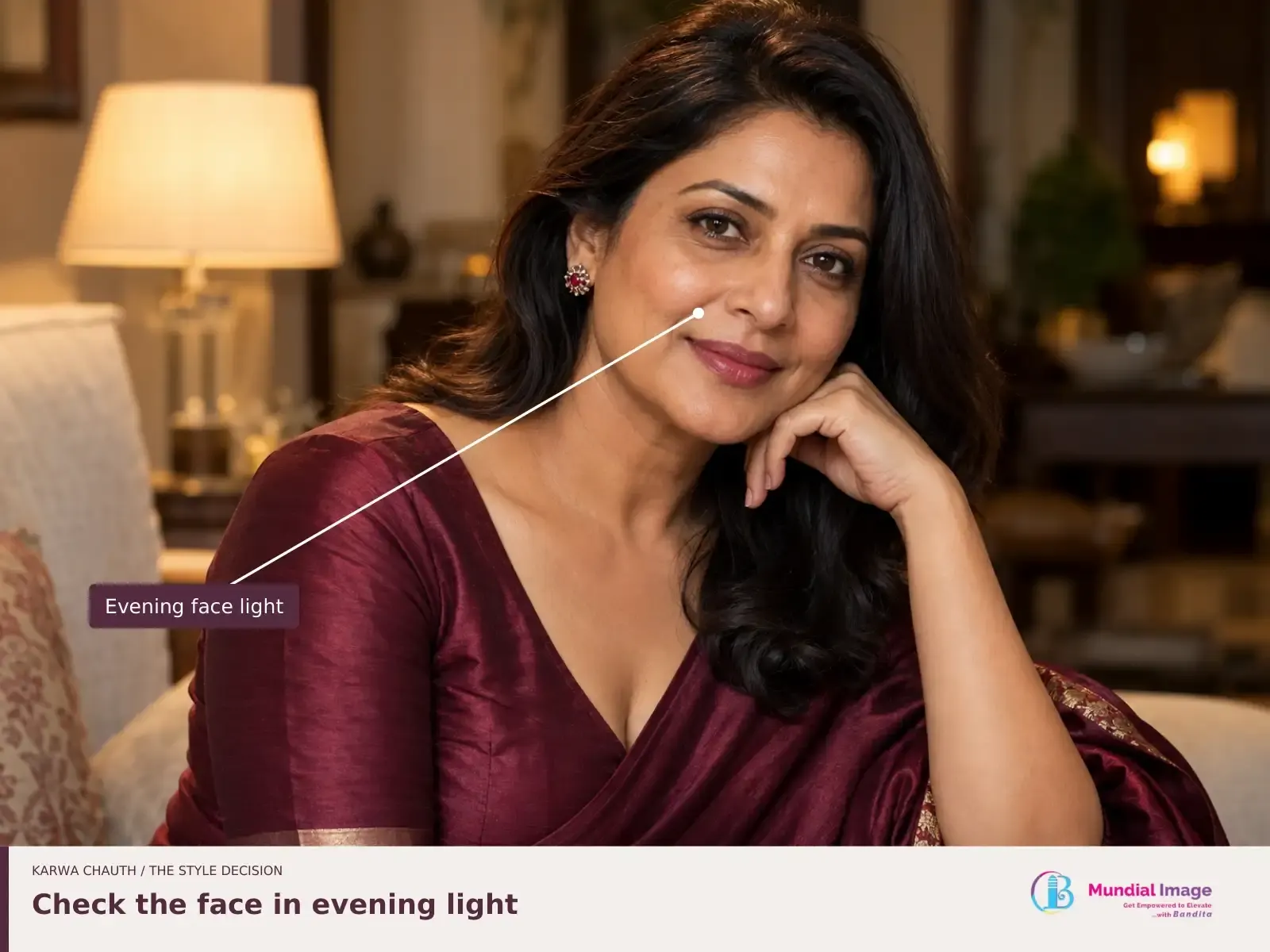
A dark terrace can make a beautiful outfit difficult to photograph. Move to a safe, evenly lit place and take a test frame.
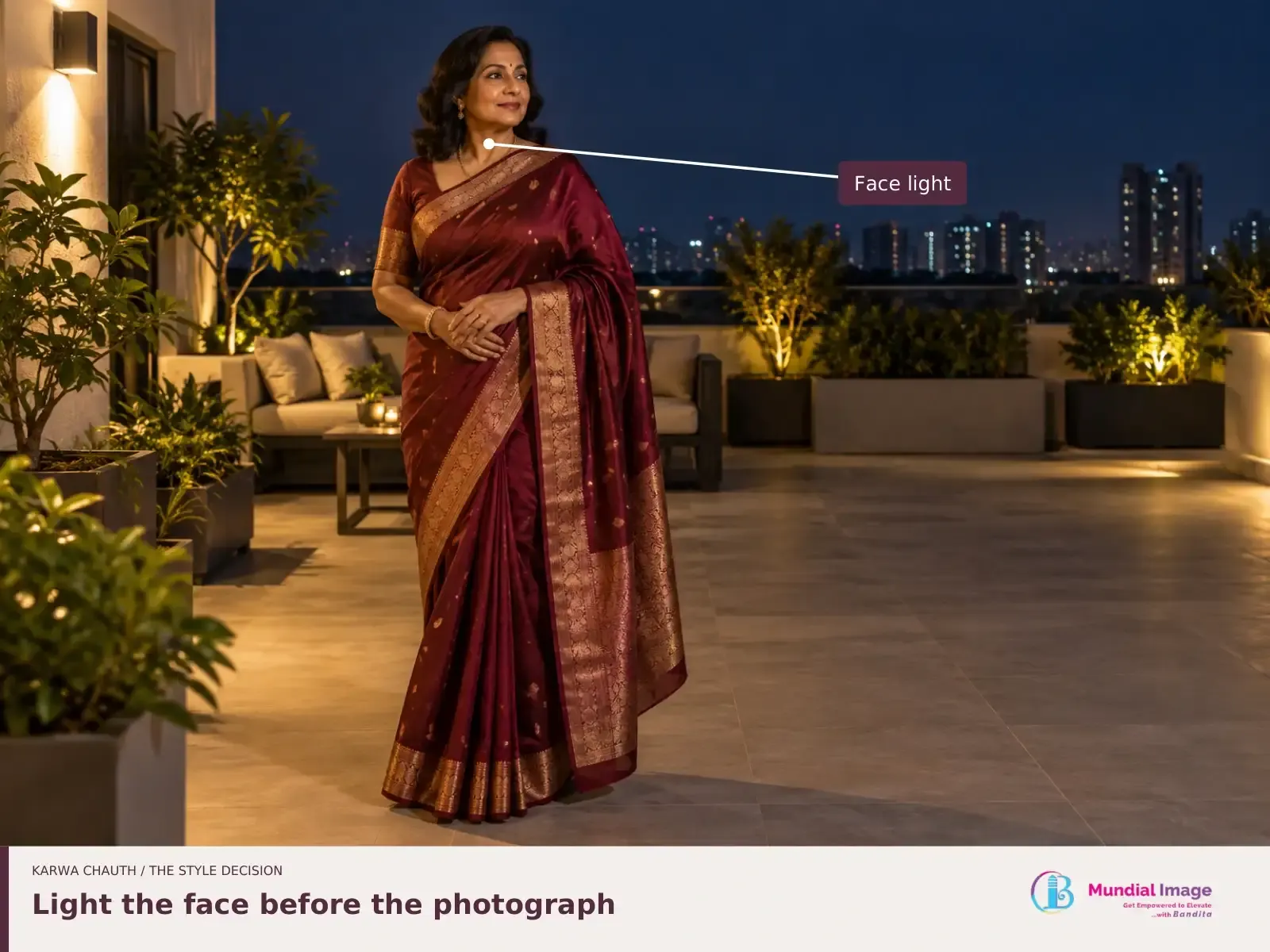
Keep space between the person and bright decorative lights behind them. Never move close to an edge or balance on furniture for a photograph.
Nikon's portrait examples demonstrate how foreground and background light can be balanced. For a phone photograph, the practical starting point is simpler: compare the picture near a soft lamp with one using the phone's flash. Judge your actual device's result.[3]
Test your actual phone. Keep away from terrace edges.
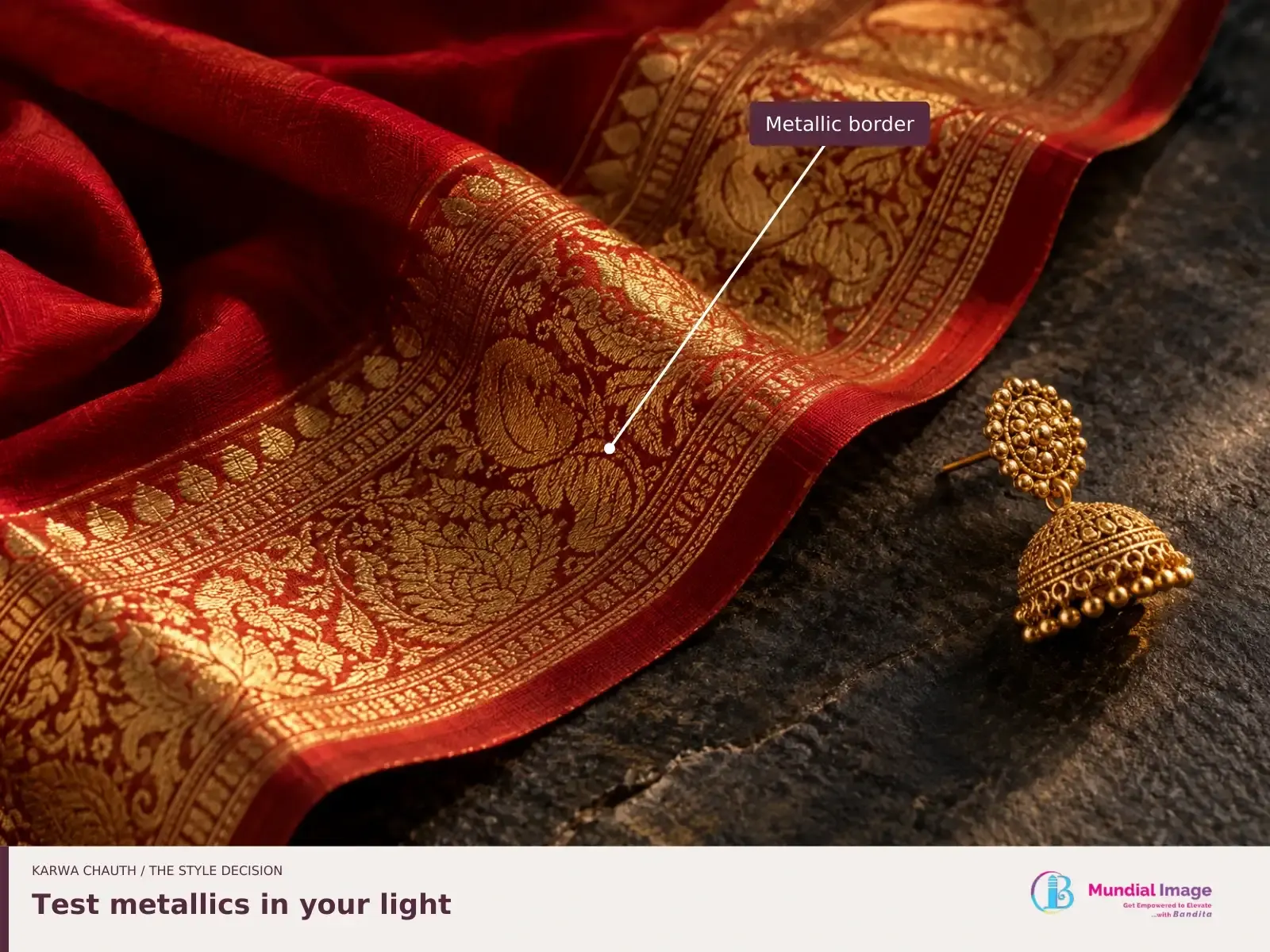
Metallic borders and jewellery can create bright reflections; a small change in angle may help. Deep wine or green may lose visible detail in dim light, while pale fabric can merge with a bright wall.
These are reasons to test, not colours to ban. Avoid assuming that one fabric, makeup finish or phone setting always photographs best.
Take a full-length image for the silhouette, a closer portrait for the neckline and jewellery, and any family pictures you want.
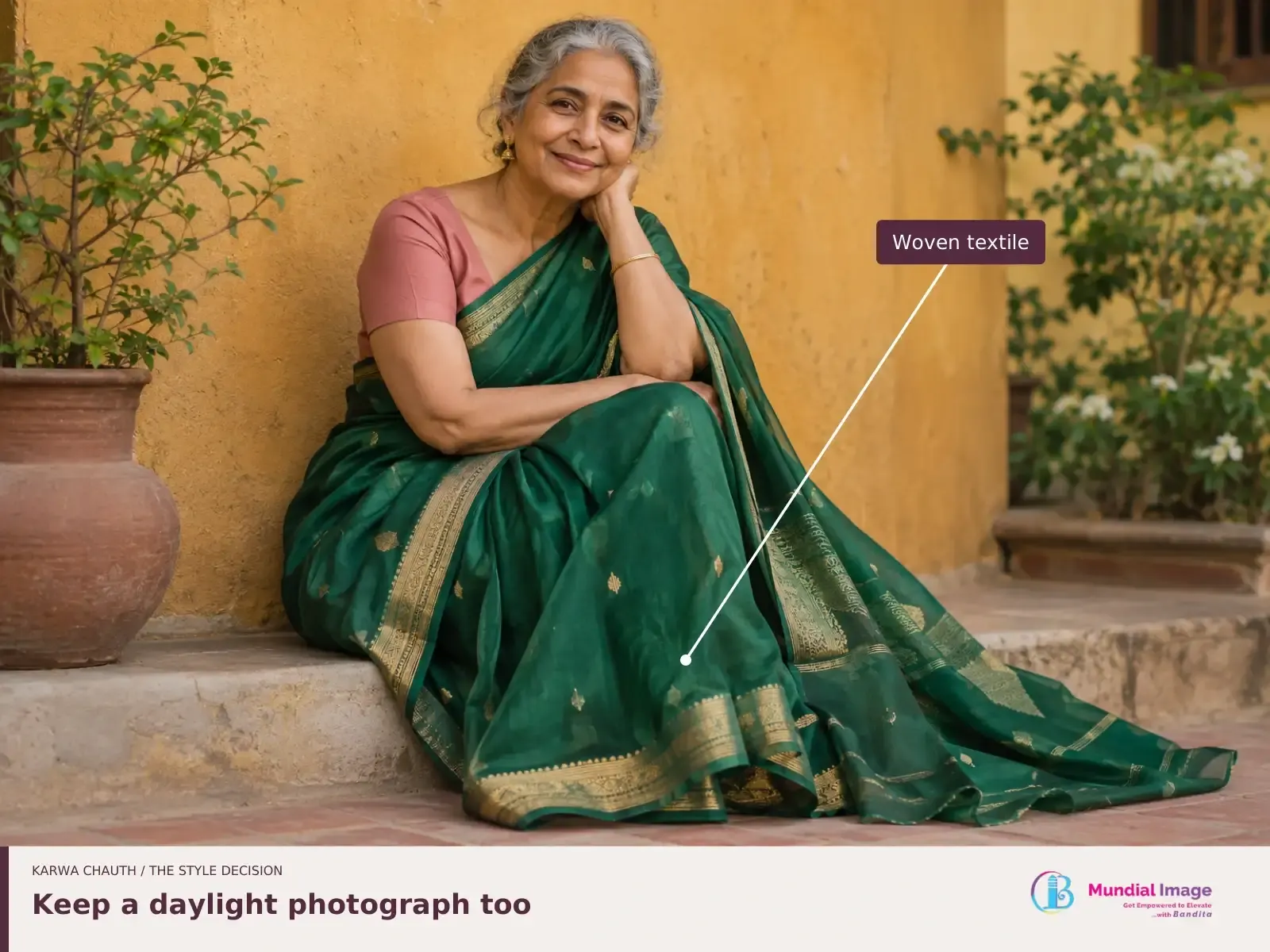
An earlier daylight photograph can preserve textile detail even if the evening light is difficult. You do not need to postpone every photograph until moonrise.
13Your style1 min
Use these as starting compositions. Swap any piece that does not belong in your wardrobe or observance.
If several routes appeal, identify the common feature: perhaps you prefer plain necklines, textile detail or hair away from the face. Mundial's Signature Style Quiz offers a further starting point for exploring those preferences.
Tap a route. Keep the preference; change any piece that does not work for you.
Plain silk saree, familiar blouse, heirloom earrings
The textile and one remembered piece
Clean co-ord or saree, sculptural earrings
Shape and an uncluttered neckline
Fluid drape or anarkali, softer contrast
Movement and a chosen colour relationship
Woven saree or wedding separates, family jewellery
Craft detail with room around it
Strong colour, defined silhouette, deliberate jewellery scale
A clear focal area in the complete look
Light suit, worked dupatta, familiar bangles
A comfortable base with meaningful details
Sharara or separates with a tonal layer
Proportion between kurta, trousers and drape
14Together1 min
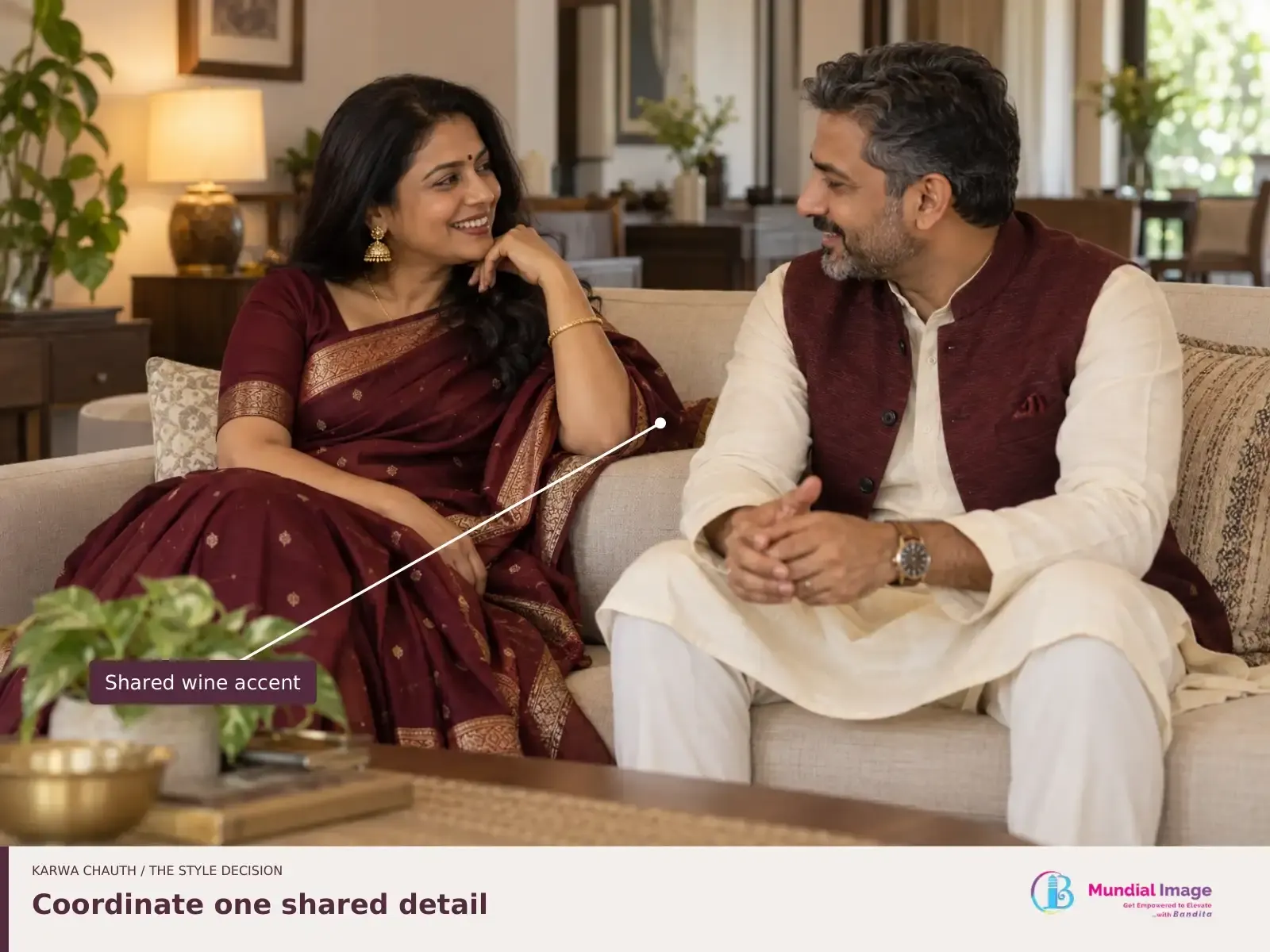
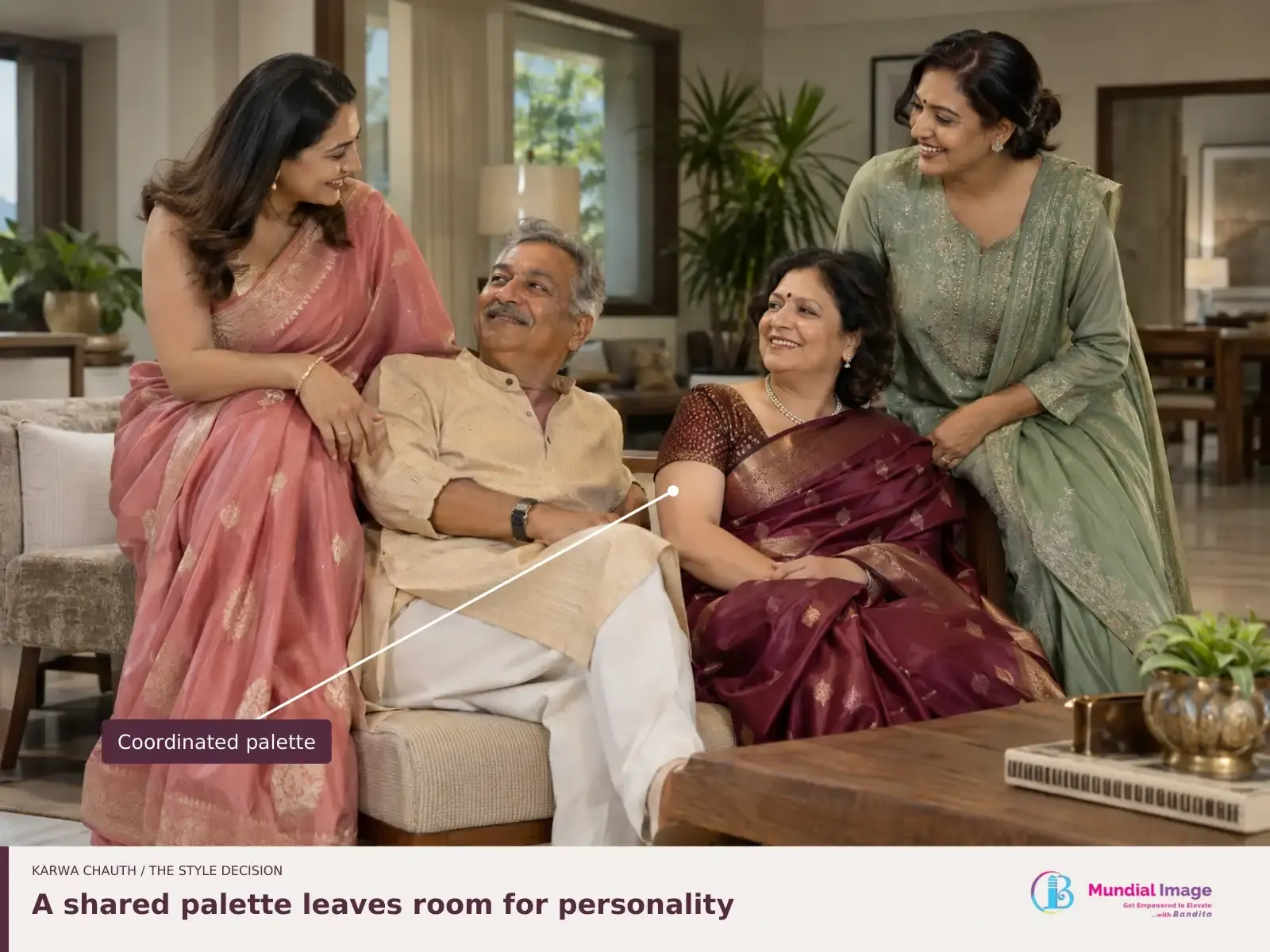
Choose one shared element: a colour family, a small accent or the level of formality. A wine saree and an ivory kurta with a wine pocket square can relate without becoming a matching set.
Each person should still choose a comfortable garment.
For a family photograph, lay the planned colours beside one another. If several people are wearing busy prints, a quieter garment elsewhere can create space.
This is a photographic choice, not a reason to police someone's favourite outfit. Let the person with a cherished garment keep it and coordinate around what is already decided.
15Before puja1 min
Avoid a brand-new drape you have not practised, a blouse checked only while standing, and jewellery chosen before the neckline. Check delicate fabric before using pins; secure a drape without putting unnecessary holes through a fragile heirloom. Keep loose fabric away from flames where lamps are used.
Do not buy an entire set because one component looks right online. Compare what you already own. And avoid copying a photograph so closely that the look loses the practical details of your own day: seating, weather, transport, available help and the time you want to spend getting ready.
Ready means wearable in the day you have planned. Tap each line as it passes.
Eight checks. About a minute.
Ready means wearable.
Dressing together this year?
Send this guide to a sister, a friend or the family group before Thursday.
16Before you ask2 min
Still deciding? Run the outfit route finder, then the comfort diagnostic in the outfit you like best.
Red is a familiar festive choice, but this guide does not set a universal colour rule. Ask about your family's customs and choose accordingly. Pink, green, wine and other colours can be considered where they fit your observance and preference.
A suit, anarkali or sharara can be a complete festive outfit. Check any family-specific expectations, then choose the garment you can wear comfortably. An elaborate suit is not automatically easier than a light, familiar saree.
Start with the day's arrangements, the traditions you choose to follow and the pieces you want to include. Try an existing saree, suit or wedding separate before shopping. A first celebration does not require a new bridal outfit.
Yes. Check current fit and condition, then decide whether to wear the original combination or separate its pieces. A plain blouse, different dupatta or smaller jewellery arrangement can change the look without altering the garment itself.
Check where the detail sits. A dense pallu and embroidered neckline may already occupy the face area; earrings alone may finish the look. A plain blouse may leave space for a necklace. Try the full combination rather than matching only by colour.
Test the intended hairstyle with the actual dupatta. Check its weight, where it rests and whether it catches earrings or shifts the hair. A low bun, braid or another familiar arrangement may work; secure and comfortable placement matters more than a hairstyle name.
There is no universal winner. Fit, lining, closures, drape familiarity, jewellery weight and footwear determine how the whole outfit feels. A seated movement test is more useful than judging comfort from a fabric label or photograph.
No. Take daylight photographs if you want a clear record of colour and textile detail. For evening pictures, test the available light and keep the face visible. The timing of your photographs is separate from the observance you follow.
NextAfter moonrise
For help assessing your own wardrobe, colour combinations and fit, explore Mundial Image's one-to-one image consulting.
Styling illustrations are AI-generated editorial images, not photographs of clients or documented rituals. Combinations are illustrative. Household observance varies.